
Time Enough for Love
Each year the ice advanced, taking ground that had once sustained the pack and forcing them closer to the others. Routes closed. Familiar places vanished beneath wind-scoured white. Moving south was no longer a decision but a drift imposed by cold.
The others gathered at night around a light that did not belong to the sky. It leapt and writhed and made the darkness recoil. She did not know what it was—only that it burned, that it consumed, and that nothing living crossed its centre and returned unchanged. The light stung the eyes. The air around it tasted of heat and ash.
But it carried a smell she understood at once: fat, marrow, sweetness. Flesh that did not run.
She waited.
When the others slept, they lay pressed together. Their scent was layered and confusing—too many bodies, too close. She had pups. She could not leave empty-mouthed. Hunger did not drive her forward all at once; it loosened caution by degrees. She placed each foot carefully, pausing whenever the light shifted or the air moved against her face.
At the edge of the warmth, where the ground had cooled and the dark returned, she saw it: a bone left where the light had burned stronger before. She took it without sound and fled.
No pursuit came.
When did the first wolf step closer than instinct allowed?
We have clues, and we can make restrained assumptions. Fourteen and a half thousand years ago—before Göbekli Tepe, before writing—a man, a woman, and their dog were buried together in what would become Bonn-Oberkassel, in modern Germany. From the remains we know the dog had suffered canine distemper as a pup, a disease normally fatal. It did not die. Almost certainly because it was cared for. Probably because it was loved.
By that time, burial itself was already customary. For such a grave to survive long enough for us to find it, the act must have been commonplace. This is the same statistical logic by which we know the world once teemed with dinosaurs, though we have recovered only a fraction of their remains.
So we move the clock back.
Thirty thousand years, then. What was happening? The maximum advance of the ice still lay a few thousand years ahead, but the damage was already severe and had been for millennia. Human groups—sapiens and Neanderthal alike—were pushed southward. So were the wolves.
If the Ice Age created the pressure, then that wolf may have approached that light twenty-five, perhaps even forty, thousand years ago.
The tale of the wolf domesticating itself is familiar and probably true. We can even watch analogous processes unfold today, as raccoons adjust their behaviour to human proximity in real time. But this is a species-bound perspective: it frames the animal as the one who adapts, and the human as unchanged.
I wonder if that is the wrong way round.
In the biting cold of the Ice Age, did the tribesman who curled around a dog survive the night when another did not? The evidence is circumstantial, but it accumulates. Where our senses are blunt, a dog’s are sharp. Where we are vulnerable—sleeping, exposed—they are alert. Where we bleed heat, they conserve it.
Some point to the extraordinary variety of dogs as evidence of the age of the relationship. It is evidence—but only of its most recent phase. Most visible variegation appears within the last ten thousand years. We have been Homo sapiens for ten or thirty times that. We have possessed brains capable of recognising advantage for roughly three hundred thousand years. We have been capable of attachment for just as long.
The Ice Age may have been the amplifier, but the ice encroached for almost our entire species’ span. Could a wolf have approached a campfire two hundred thousand years ago? There is no principled reason to think not.
And two hundred thousand years is enough time not merely to adapt bodies, but to shape expectations—enough time to test trust, to punish betrayal, to reward alliance.
Enough time to evolve.
Together.
Symbiosis — Og and Dog
There are vanishingly few examples of inter-species emotional compatibility.
Egyptian plovers are tolerated by Nile crocodiles as dental hygienists, but this is a non-sentimental arrangement: a narrow truce, a hard quid pro quo. Remoras attach themselves to sharks to catch scraps; they are tolerated only so long as they are not worth the effort of removal. Groupers suppress the instinct to eat cleaner fish, but only under strict conditions. Most of the symbioses we point to—clownfish and anemones, fungi and roots—are unconscious collaborations: deep, effective, and mindless. A few, such as oxpeckers and oxen, function well enough, but neither party cares about the other in any meaningful sense.
These are arrangements, not relationships.
The human–dog bond is different, and the difference is biochemical as much as behavioural. Oxytocin—the hormone associated with attachment, trust, and parental bonding—is released in both humans and dogs during sustained mutual gaze. This is not simple conditioning. It is the same mechanism that binds infants to caregivers and partners to one another. No other inter-species pairing is known to trigger it so reliably, in both directions.
The consequences are stark. Humans will risk—and sometimes give—their lives for dogs. Dogs will do the same for humans, and for human children in particular. This is not performative loyalty or trained behaviour; it is costly, reciprocal, and appears even in the absence of instruction. A dog will place itself between danger and a human infant without calculation. A human will do the same for a dog.
No other pairing comes close.
This cannot be explained by socialisation alone. Socialisation produces tolerance, habit, and utility. It does not produce mutual sacrifice. Oxytocin does. And oxytocin does not lie: it marks attachment where attachment has been selected for, reinforced, and stabilised over time.
Many dog owners today—particularly solitary ones—prefer the company of their animals to that of other humans. Men otherwise hardened by life are undone by a puppy, or by the death of their dog. This response is often treated as modern sentimentality, a luxury of safe societies. But there is no reason to assume it is new.
Accounts—some reliable, others fragmentary—exist of human infants surviving for extended periods in wolf or dog territory. Whether every detail withstands scrutiny is beside the point. The question remains unavoidable: why was the infant not eaten? Any fawn or rabbit would have been prey. Something in the signal was read differently. Something was recognised.
I suspect a biological attunement had already taken place. Not learned, not moralised—embodied. An alignment now written into our nervous systems: a symbiosis not just of bodies, but of trust.
And it may have begun tentatively, long before we had language, before we had morals, before we had names for what we were doing at all.
The Time Before Morals
Morality as we understand it is young—measured in thousands of years at most, shaped by religion, law, and expanding social scale. Before morality there was the tribe, and before doctrine there was mutual dependence.
I wonder whether our interdependence with dogs was already present at the beginning—and if it was, whether it taught us anything.
We care most fiercely for those we love, and less intensely as we move outward through widening circles of familiarity. The first sustained relationship with dogs required us to care for another animal not as prey, not as rival, but as partner. It may have taught us that collaboration could cross boundaries. That trust could extend beyond kin. That protection could be reciprocal.
In that sense, the dog may not merely have accompanied society.
It may have accelerated it.
Now and Forever
Today, dogs of every shape and size are bred, cloned, trained, mourned, and memorialised. In some modern societies, a third of households include a dog. We treat cruelty to dogs as a sign of moral fracture, even pathology. We have made room for them in our imagined afterlives.
Martin Luther—the architect of the Reformation, a man not given to sentiment—is reported to have comforted his dying dog with the words:
“Be thou comforted, little dog; for in the Resurrection thou too shalt have a little golden tail.”
Whether apocryphal or not, the impulse is revealing. Doctrine bends. Love does not.
Dogs are with us still.
In our genes.
In our habits.
In our hearts.
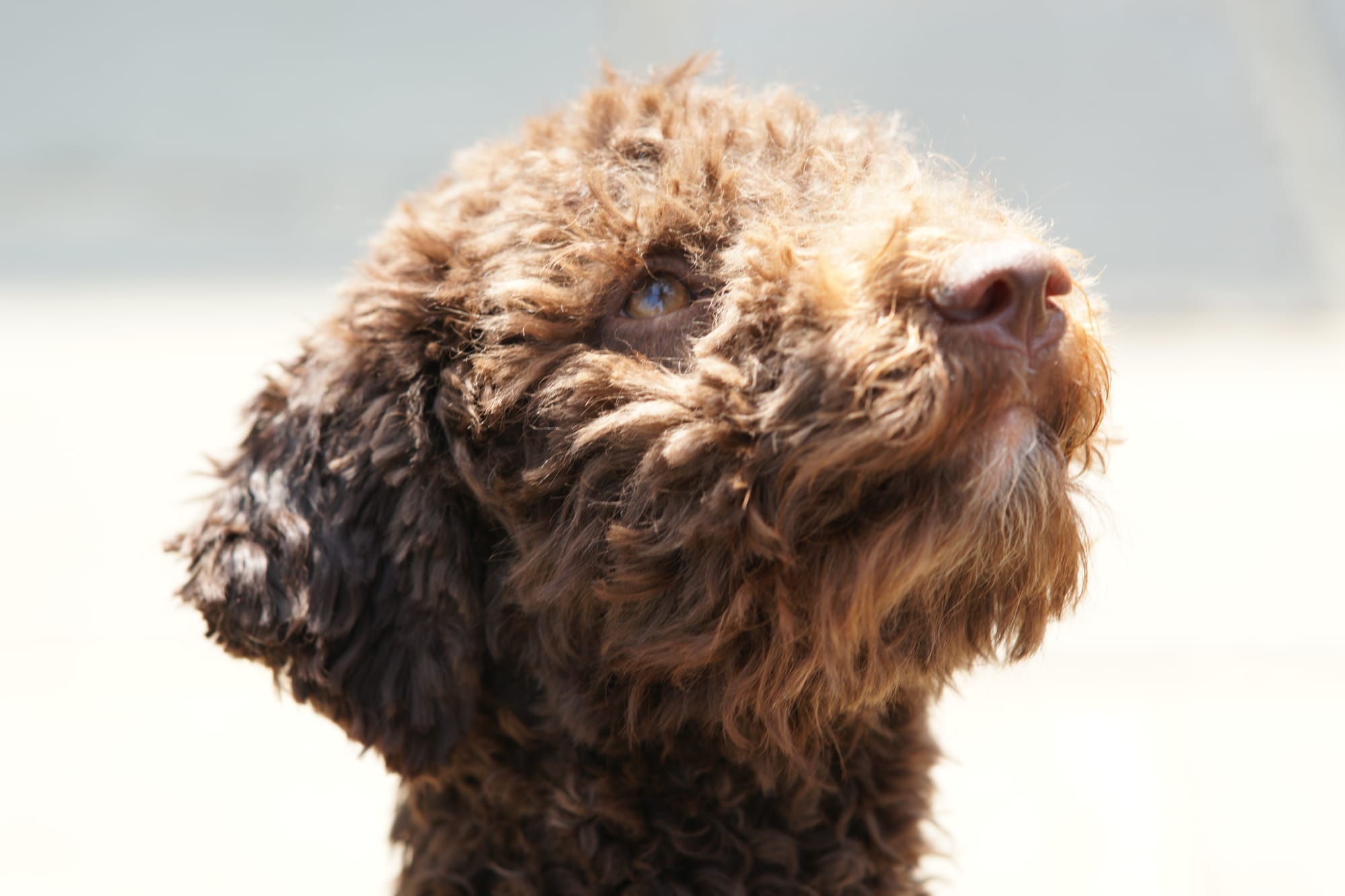
This essay is dedicated to Truffle. December 2012 to January 2026.
Discussion