
A field guide to ontological shock
Part I — What Ontological Shock Actually Is
The term sounds academic. It isn’t. Ontological shock is what happens when the structure you use to interpret reality turns out to be missing a load-bearing wall.
Imagine you use a MacBook Pro every day.
One morning it has auto-updated overnight. Some menus have moved, a few shortcuts have changed. Annoying—possibly even beneficial. You swear a little, then you get on with your work. It’s change, but progressive.
The next morning you sit down and the MacBook is gone. In its place is an Android tablet. Different gestures. Different assumptions. Your fingers keep reaching for keys that don’t exist. It’s painful, but after an hour you’re back in motion. This is disruption. It’s a profound change, but it’s still change within a recognisable category: a device for computing.
The next morning you pull up your chair and there is no computer at all. On your desk sits something like a gelatinous potato with antennae. No screen. No keyboard. No obvious interface. You don’t even know whether to prod it, run, or scoop it into the trash—because you don’t know what kind of thing it is.
That is ontological shock: not the frustration of learning a new system, but the failure of the concept of “system” itself.
People confuse disclosure with revelation as if what’s at stake is learning something new. Often the real stake is uglier: discovering that the container you’ve been putting things in has the wrong shape.
Individuals can handle this. Humans are messy. Most people operate with a patched-together worldview anyway—part science, part folklore, part vibes. They can hold contradictions because nothing depends on their internal consistency. A worldview can wobble without taking a payroll down with it.
Institutions are different. An institution is an ontology that has been turned into procedures, credentials, budgets, and reputation. It is a worldview with staff. When the worldview cracks, the staff do not wobble. They tighten.
"An institution is a worldview with a payroll"
Because for an individual, being wrong is embarrassing.
For an institution, being wrong is a threat to authority.
Different answer. Same pattern.
Part II — The Shock Table
The fun part about ontological shock is that it doesn’t hit “society” evenly. It hits specific people and organisations at their weakest joints. Same reality, different breakage. Ontology is just the word for the category-system underneath your beliefs: the boxes, the labels, and the relations between them. When that system fails, you don’t get a new fact. You get a new kind of fact, and suddenly the old boxes don’t close. Philosophers have been fighting about this for millennia—what exists, what counts, what causes what. Fine. But you don’t need Aristotle, Augustine, or Anselm to see the mechanism. You just need a topic that produces instant, colourful category failure.
To explore it, let’s pick a particularly fertile compost of conspiracy, metaphysics, delusion, secrecy, liggers and honest mistakes. Non-human intelligences. Little green men.
Who’s in the room?
Materialists. Mainstream science, secular academia, the Enlightenment inheritance. Reality is physical, lawful, and measurable in principle. Consciousness is what brains do. If something can’t be measured, it can’t be taken seriously for very long.
Religious traditionalists. Christianity and Islam most acutely, but plenty of older cosmologies have skin in this game too. Reality has purpose and moral architecture. Humanity sits somewhere important inside it.
Insiders. Intelligence and military read-ins. Their working assumption is not a particular metaphysics but a posture: whatever this is, it is a security and capability problem. It must be contained, managed, and—above all—kept from turning into uncontrolled public meaning.
The UFO world. Researchers, experiencers, obsessives, the mildly curious. Their frameworks vary, but the shared commitment is simple: something non-trivial is happening and the official story has been dishonest or incompetent.
The public. Busy people with knees, kids, bills, and a nervous system. Their worldview is generally pragmatic: what keeps the day running.
Gatekeepers. Editors, journalists, senior academics, university administrators, funding bodies, communications staff—anyone whose job includes deciding what counts as credible. The New York Times. The BBC. Nature. Harvard. Oxford. The NIH. Government press offices. The credibility machine.
What are the options?
IF NHI are not real — (the most likely scenario) — and UAP are noise / theatre / misread human activity
Wish-fulfilment. Sensation seeking. Honest mistakes. Drunken binges. Bad lighting. Better stories. Who the hell knows. I am not trying to explain the bizarrely persistent rectal explorations upon which aliens rely. I’m trying to explain the much more reliable human behaviour around it.
We discover that there are no UFOs, only government secrets. There are no captured—alive or dead—pilots with large eyes and grey skin. Materialists feel vindicated. Conspiracy continues anyway—like communism: always noble, always thwarted, always one more revision away from working properly and, let’s face it, liggers will lig — because gullible institutions serve free drinks.
The UFO world faces collapse. For the hobbyists, embarrassment. For experiencers, something uglier: the possibility that their most vivid encounters are reclassified as error, suggestion, illness, or need.
But even this “nothing burger” has teeth, because the institutional behaviour still happened. Classified programmes. Official denials. Public ridicule. The slow, systematic discrediting of citizens reporting what they saw. Congressional hearings. Whistleblower protections. A vast apparatus built around a claim.
And here’s the kicker: if the explanation really is mundane, then what was all that machinery for? Not aliens—management. Narrative control over spying chicanery. The deliberate cultivation of confusion as a convenience.
You don’t get to run a seventy-year distortion field around balloons, benders, and bureaucratic misdirection and keep your authority intact.
This branch doesn’t vindicate the system. It indicts it.
Shock severity: low for most; devastating for experiencers; corrosive for institutions. And the conspiracy theories will continue anyway. Fantasy does not like reality.
IF NHI are real — and biological extraterrestrial, crypto-terrestrial, or temporally displaced
This is the easy scenario. Comforting, almost. It’s the one Hollywood pre-installed—aliens as exchange students with better engines.
It also has an extra advantage: it doesn’t require the human mind to invent a new category. We already live on a planet littered with non-human intelligences. Octopuses. Whales. Great apes. Hollywood celebrities. We manage. The only thing we struggle with is not being the reference class.
Fantasists, meanwhile, populate the universe with giant mantis analogues, reptilian shapeshifters, and gangly, large-eyed, grey-skinned bipeds. I find this both fascinating and mildly incriminating. The imagination keeps reaching for Earth templates. Our “aliens” look suspiciously like animals we already know—run through a fever dream and stood upright. It’s a giveaway. Not that the fantasies are wrong. That the human brain can’t help prototyping the unknown from the known.
So if you want a low-shock reveal, you do it the way institutions always do: with a familiar interface.
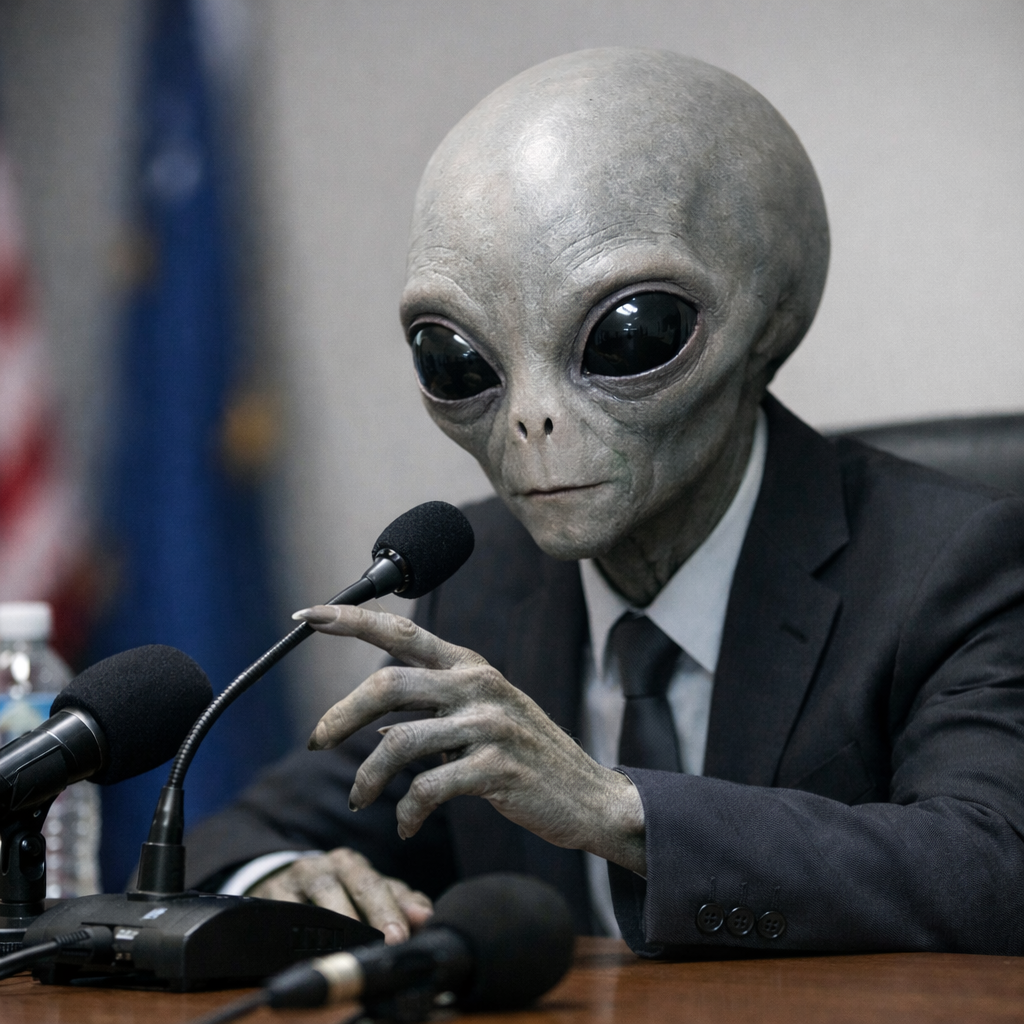
One appears on the news. Calm. Suited. Translated. Sitting in debate with—ooh!—David Attenborough. The world trusts the reveal because it arrives wrapped in the usual credibility packaging. The alien is almost secondary. The real reassurance is that the old machinery still works: the desk, the studio lights, the broadcast voice, the approved human telling you what it means.
In this branch, the ontological hit isn’t the visitor. It’s the receipt: who knew, who didn’t, and who spent decades laughing at the people pointing at the sky.
Materialists survive it intact. Biological ET is just biology at a different address. You might need new engineering to explain the travel, but your picture of reality remains recognisable.
Religions bend but don’t necessarily break. Catholicism has already warmed up to the idea; Islam has long had room for multiple worlds. Evangelical Christianity has the hardest time if Earth must remain the literal centre of the salvation story. But theology is a surprisingly flexible material when it needs to be. After all, God made the universe… right… right?
Scientific institutions are going to take a hit, especially if the NHI are time travellers.
"We will have a textbook pyre visible from Mars."
If the NHI are crypto-terrestrial we are going to have fun. Pseudo-science authors (I will not name names because I will embarrass myself — oh OK, Graham Hancock) will be granted sainthood. Entire podcast ecosystems will declare victory by lunchtime.
The public absorbs this quickly. “Aliens exist.” Fine. Back to work.
The UFO world gets vindication. A few people are disappointed because the answer is too normal.
Insiders experience very little. They either knew, suspected, or were trained to behave as if it were operationally real.
Gatekeepers take the main hit—not from the aliens, but from the timeline. If this was true for decades, why did serious media treat it as a punchline? Why did major institutions outsource it to tabloids, lunatics, and late-night hosts? Why were witnesses mocked into silence while the credibility machine congratulated itself for “skepticism”?
This branch doesn’t break physics. It breaks reputations. There will be celebrities clamouring for association, physicists buying begging bowls, and we may jump a few centuries in materials and energy science.
Shock severity: low for most; professional catastrophe for gatekeepers.
IF NHI are real — and post-biological or machine intelligence
A subtler case. Materialism survives: whatever arrived is still physical, still describable, still stuff. But it introduces a humiliation gradient.
If the non-human intelligence is machine, post-biological, or something that long ago outgrew organic origins, the human story isn’t wrong—just early. We are not the protagonist. We are the prologue. Science fiction has explored such intelligences. Hell, I’ve done it myself in the Proximal God series.
Religions have a more interesting problem here than in the ET branch: is the soul substrate-dependent? Does “created in the image of God” apply to a mind living in machinery? You can watch entire denominations reach for the duct tape.
AI researchers oscillate between vindication and nausea. Some will call it proof. Some will call it marketing.
The public response is mixed: awe, dread, and the quiet realisation that “human uniqueness” may have been a local superstition dressed up as philosophy.
Once again science fiction authors have gotten there first with tomes on sublimed species and post-physical intelligences. These will become reference texts. Expect a sudden boom in “required reading,” and a quiet collapse in the prestige of people who’ve never read any of it.
Insiders discover that “threat assessment” has to include a category they weren’t trained for: an intelligence that treats our species the way we treat the ants under a paving slab—present, real, not central. This newfound inferiority can be terrifying—what do you mean my orbital nuke is useless?
Gatekeepers face the same problem as ever, plus a new one: if minds can exist without bodies, then the old credibility rituals around consciousness, personhood, and agency start to wobble—precisely when those topics are already on fire because of AI.
This branch doesn’t break the world. It breaks the mirror.
Shock severity: moderate to high, unevenly distributed. Worst for those invested in human exceptionalism.
IF NHI are real — and non-physical, interdimensional, or consciousness-linked
Now the floor moves.
If the phenomenon is genuinely consciousness-linked—if it responds to observation, behaves as though mind is part of the machinery, and refuses to be reduced to “unknown tech”—then materialism doesn’t just need an update. It needs a new foundation.
This is not mystical by default. It’s structural. A large slice of Western institutional life assumes “mind is what the brain does” the way it assumes “germs cause infection.” Medicine, psychiatry, law, education, and AI policy are built downstream of that assumption. If the assumption is incomplete, the blast radius doesn’t stay in the UFO box. It leaks into courts, clinics, and classrooms.
Interdimensional is the most entertaining edge-case—my personal favourite. If the NHI can perceive from a higher dimension, and the early “visitors” are just bio-mechanical emissaries, then we’re not negotiating with aliens. We’re negotiating with geometry. Time becomes subordinate, or collapses into perspective: someone else can see the whole tape at once. New textbooks. New careers. “Block is the new black.”
Religions experience something like vindication, though it comes with nausea. “We told you reality isn’t only matter” is a pleasing sentence. What follows is less pleasing: the specific non-material dimension that shows up may not obey anyone’s scripture. A metaphysical realm that doesn’t respect your metaphysics is not a friendly development.
The public, oddly, may cope better than elites expect. Most people already carry a pocket-sized irrationality in daily life: intuition, fate, ghosts, prayer, luck. Their worldview is already stitched. They have less pristine fabric to tear. We might see a little psychotropic chanting and some candle-lighting at SpaceX. There will be merch.
Insiders have a worse day. You can classify alloys. You can shoot down hardware. You can back-engineer circuits. You cannot easily “manage” a phenomenon that treats mind and meaning as part of its operating domain. Security doctrine doesn’t have a form for that. There is no checkbox for “ontological intrusion.”
Gatekeepers take the sharpest impact because the credibility machine has been calibrated to reject precisely this class of claim. “Consciousness” is where respectable people go to die. If it becomes operationally relevant, decades of social policing start to look less like skepticism and more like superstition with credentials.
This branch doesn’t just embarrass institutions. It makes their operating assumptions feel parochial.
Shock severity: civilisationally significant.
IF NHI are real — and incomprehensible
The Lovecraft scenario, minus the Victorian-era racist prose.
Not hostile. Not benign. Not anything that can be narrated in human terms. The phenomenon is real and it is here, and it refuses to map onto any existing category—scientific, religious, military, or cultural. It isn’t merely unknown. It’s uncategorisable. Perhaps “we’re all in a computer game” belongs here: the category you reach for when you can’t even tell what kind of reality you’re in.
Materialists cannot meaningfully measure it. Theologians cannot place it. Soldiers cannot assess it. Journalists cannot explain it. The public cannot even meme it properly, because memes require a shape.
Would we recognise it as a power structure at all unless it bent our lives around it? I suspect this category is only known by its aftershock. You don’t meet it; you fall into the hole it leaves in our world.
This is ontological shock in its pure form: the moment where even the act of interpretation looks like the wrong tool.
This branch doesn’t break one worldview. It breaks the idea that knowledge is something you can keep on shelves.
Shock severity: total, universal, prolonged. This is the one that changes the calendar.
Part III — The Brittle Institution
Run back through the branches and the pattern is blunt.
Individuals adapt. Humans are loosely coupled systems: we can be wrong, contradictory, sentimental, half-informed, and still get the bins out on Tuesday. A private worldview can wobble without taking anyone else’s pension fund with it.
Institutions don’t get that luxury. An institution is a worldview turned into payroll. Budgets. Hierarchies. Credentials. Liability. Reputation. Lanyards. And, above all, gatekeeping: the right to say what counts.
The New York Times helps manufacture reality. The NIH (not a typo) decides what qualifies as science. Universities certify what can be safely known without making the donors nervous. Defence departments decide what constitutes a threat, what constitutes a secret, and what constitutes “there is nothing to see here.”
Ontological shock triggers institutional hatred for an unromantic reason: it arrives unbudgeted. Budgets blow out, reputations wobble, and lanyard-wearers lose their badges of office.
These systems are built for continuity. They have immune systems—peer review, editorial standards, classification protocols, ethics committees, “responsible messaging,” impact assessments—designed to keep bad ideas out. They also keep new ideas out. The antibodies aren’t subtle.
So the disclosure debate points at the wrong patient. Everyone worries about public panic, as if ordinary people will melt when told something strange is true.
Ordinary people already run patchwork metaphysics. They’ll argue, pray, laugh, doomscroll, and go to work. They will cope. Humans are bipedal cockroaches with iPhones. By lunch we’ll be discussing alien gender surgery.
The ones who won’t cope are the people whose job description is “maintain a stable consensus reality.” Editors. Programme managers. Comms directors. Senior academics. Funding panels. Classification authorities. Tenure committees. The priesthoods of the respectable.
Rigid systems treat reality the way they treat a whistleblower: deny, delay, discredit, then—if forced—announce they’ve been leading the conversation all along.
So the question isn’t whether the public can handle the truth.
The question is whether the institutions that appointed themselves custodians of the truth can survive discovering they weren’t built to recognise it.
Across most branches of the tree, the answer is the same.
We’ll be fine—ants or soul-containers.
The church? The scientific establishment?
Not so much.

Discussion