
We live in an age intoxicated by solutions.
Not modest ones. Not patient ones. We prefer the kind that announce themselves—large, confident interventions that arrive with funding rounds, press releases, and a sense of moral self-approval. We admire action. We reward scale. We are deeply suspicious of anything that looks like waiting.
This is not because we lack compassion. It is because compassion, when paired with wealth and power, has developed a vanity problem.
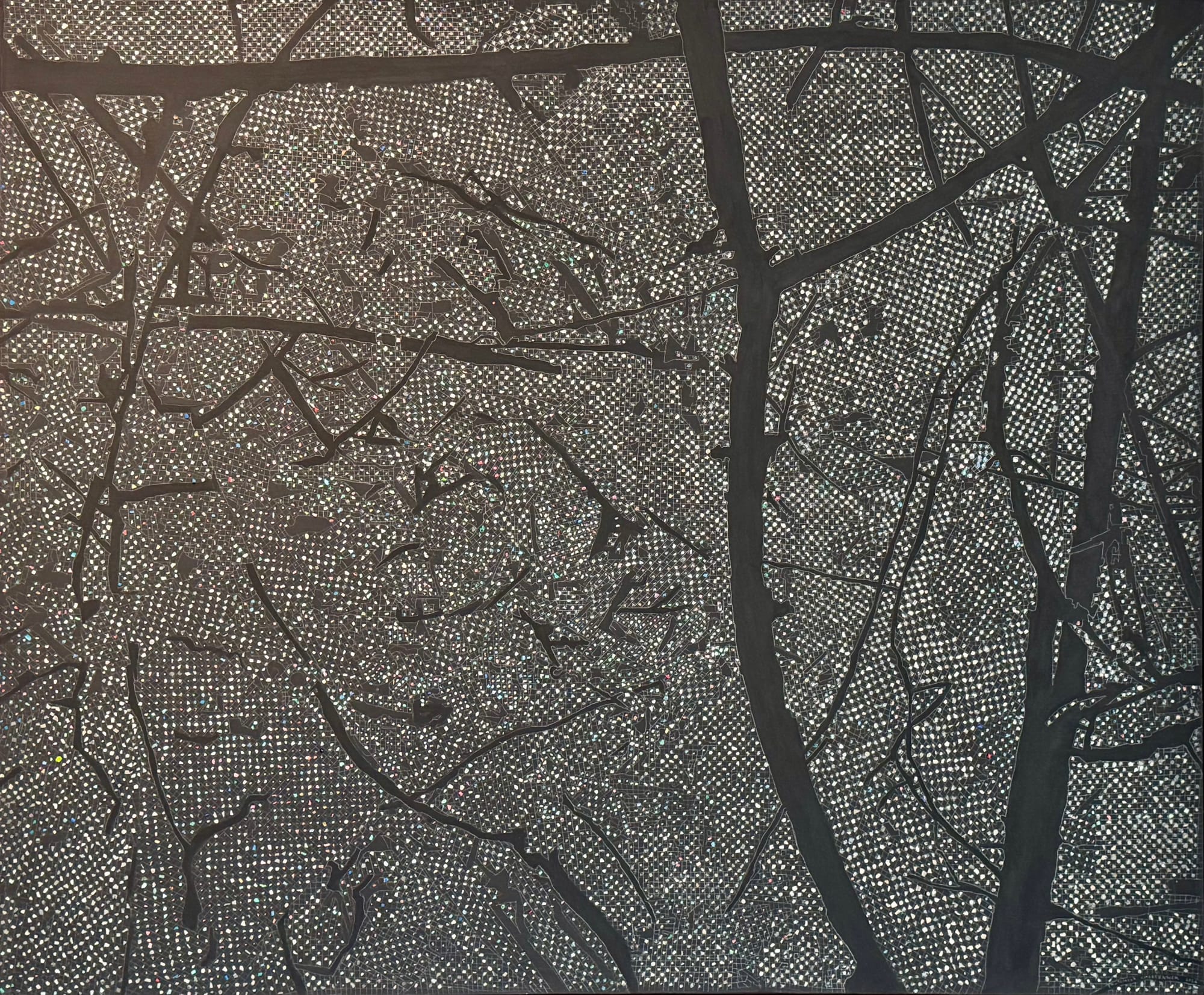
I recently bought an artwork by a Thai artist who collects microplastic fragments from local beaches and painstakingly incorporates them into large, expressive works. They are beautiful in a quietly accusatory way. Each fragment is trivial on its own. Together they form something indelible. Plastic was once a good idea: clean, light, modern. No one set out to seed the oceans, the food chain, and our own bloodstreams with indestructible confetti. The damage emerged because the material was repeated at scale for just long enough that its consequences could arrive invisibly, politely, and somewhere else.
That is increasingly how harm enters the world.
Through confidence. Through intervention. Through the belief that the ability to act creates an obligation to do so.
This is not an argument against progress, technology, or large human endeavour. Fossil fuels, for example, were not a vanity project. They were a blunt answer to a harsh world: cold homes, hunger, back-breaking labour. Coal and oil replaced muscle with heat. They shortened winter and lengthened lives. Their adoption was not an experiment in planetary engineering; it was survival by any available means. Acknowledging their later costs does not require pretending they were conceived as a moral failure.
The real danger appears later, once survival has been secured and power turns its attention to optimisation. To the conviction that nature, society, or humanity itself would benefit from a firm guiding hand, provided that hand is sufficiently informed, well-funded, and morally certain.
This is where vanity enters. The polished vanity of benevolence: the preference for solutions that look impressive over systems that quietly endure.
Resilience is deeply unfashionable. It does not photograph well. It produces no launch dates. No one cuts a ribbon for a system that absorbs shocks without spectacle. No donor receives applause for a disaster that never materialised.
Grand interventions, by contrast, flatter their authors. They produce metrics. They scale. They promise control.
Medicine provides some of the clearest examples, precisely because the intentions were unimpeachable.
Thalidomide was prescribed to pregnant women as a modern, humane solution to morning sickness. It was tested. It was endorsed. It was dispensed with confidence. The resulting birth defects were not the product of cruelty, but of certainty arriving before understanding. The lesson was not that medicine should stop trying, but that the human body is not a system that rewards haste dressed up as virtue.
Nutrition policy offers a slower, quieter version of the same mistake. The food pyramid reduced a complex metabolic reality to a tidy diagram. Fat became the villain. Carbohydrates were rehabilitated. Industry complied enthusiastically. Sugar slipped into everything. The intervention looked scientific, actionable, and public-spirited. The consequences—obesity, diabetes, metabolic disease—emerged over decades and were reclassified as personal failure rather than systemic overreach. Authority acted. Bodies paid.
Consider China’s one-child policy. A state decided that demographic complexity could be managed with a single lever. Fertility was treated as a production variable. The policy was decisive, enforceable, and legible. Its consequences unfolded more slowly: demographic imbalance, an ageing population unsupported by its own future, social distortion, and a human cost dismissed as administrative friction. This was not ignorance. It was confidence exercised at scale.
Forests offer a parallel lesson. Fire unsettles the public. Smoke alarms voters. Burning looks like failure. So we suppressed it. Small fires were eliminated. Fuel accumulated. Forests thickened. When fire returned, it arrived with a ferocity that suppression had patiently prepared. Risk was not removed. It was stored.
Rivers have followed the same moral choreography. First we straightened them, confined them, disciplined them with levees and concrete. Flooding appeared solved—until floodplains starved, deltas eroded, and water resumed its old habit of going where it pleased. Floods returned larger, faster, and displaced. The problem was not solved. It was deferred.
Now the pendulum swings back with equal confidence. Dredging is halted in the name of ecological sensitivity. Channels narrow. Sediment accumulates. Water levels rise. Floods follow. The moral logic is familiar: protect the microfauna, restore nature, assume the system will quietly rebalance. Instead, risk is relocated to towns, homes, and fields downstream.
It is the same mistake in a cleaner costume. Like refusing to clear underbrush in a forest to protect every beetle, only to discover that fuel does not moralise when it burns.
Agriculture supplies further examples. Feeding the world became a slogan. Complexity became an inconvenience. Nutrient cycles were simplified. Monocultures expanded. Fertilisers flowed. For a time, the results looked like progress. Then downstream systems began to fail quietly: dead zones, collapsing fisheries, soils exhausted by efficiency. Scale was mistaken for understanding.
The pattern is consistent. A complex system is confronted. A powerful actor decides to improve it. The intervention is large, legible, and morally gratifying. The consequences arrive later, spread across time and geography, borne by people who were never consulted.
Resilience would have looked different. Smaller burns. Space for rivers. Maintenance instead of symbolism. Redundancy in place of optimisation. Biological diversity versus mono-culture. None of this is exciting. None of it flatters power. All of it assumes fallibility.
Which brings us to the most impressive proposal yet.
The planet is warming. The system is sensitive. Feedbacks are real. The temptation follows naturally: dim the lights.
Why not inject reflective particles into the stratosphere and take the edge off the sun? The idea is bold. It is technically conceivable. It has models, panels, a seductive air of competence and some billionaire support. It also carries the unmistakable scent of an intervention designed to look decisive rather than to endure error.
Nature already provides enough uncertainty. Super-volcanoes capable of darkening skies for years. Asteroids with extinction-level potential. Earthquakes, tsunamis, pandemics. None can be prevented. All must be endured.
The appropriate response to unavoidable catastrophe is resilience. It is preparation without theatrics. It is the refusal to add new fragilities to an already volatile world. When the universe is already armed, introducing experimental risks because they are technically feasible is not courage. It is indulgence.
Resilience accepts that we are clever, but not omniscient. It designs systems on the assumption that their designers will be wrong. It values slack over speed, buffers over brilliance, and patience over spectacle. Vanity assumes mastery and mistakes action for wisdom.
We should be wary of solutions justified primarily by their scale. We should distrust interventions that rely on confidence in systems we barely understand. We should ask whether the urge to act is driven by necessity, or by the desire to feel important.
Hands up for deliberately dulling the sun’s rays by throwing micro-particulates into our stratosphere?

Discussion