
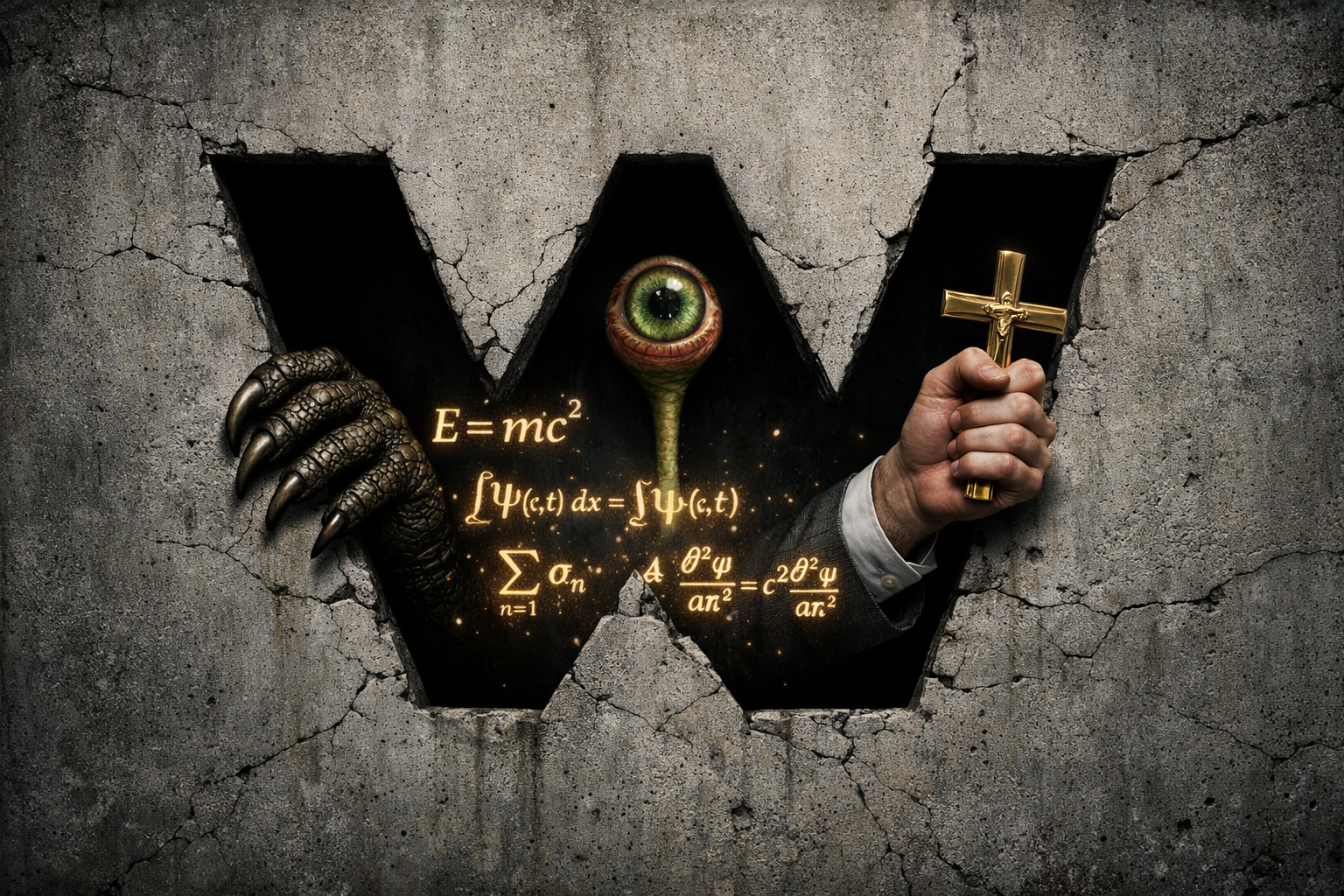
I. The Misframed Argument
We like to imagine that the great arguments of our age are about belief versus reason. Faith versus science. Superstition versus knowledge. One side clings to invisible beings, the other insists on evidence. This story comforts us, because it flatters everyone involved.
But we are having a different argument entirely, and almost nobody has noticed.
Listen past the slogans. Atheists and the religious both talk constantly about things that cannot be seen. Both appeal to invisible structure. Both rely on entities located nowhere in ordinary space: laws, fields, forces, purposes, principles. The most hard-nosed materialist will speak casually about "what the universe allows," as though the cosmos had tastes. The Archbishop, meanwhile, will insist that God is not a being among beings, that He is beyond category, beyond space, and somehow fail to notice that this sounds exactly like a physicist describing a field.
If the disagreement were really about whether invisible structure exists, the conversation would have ended centuries ago. It hasn't.
What we are actually arguing about is whether invisible structure is allowed to have a face.
The pressure is almost universal: the sense that something essential is missing from our picture of the world. It shows up in religion, in metaphysics, in physics, and increasingly in popular culture. We feel it when explanations work locally but collapse globally. When correlations persist without contact. When laws govern without inhabiting anything. The world behaves as though it has more room than we can see.
Not mystery. Mystery suggests ignorance. What we experience is misfit. A description that works perfectly well everywhere you test it, and somehow fails to describe the thing.
The usual language is metaphorical. Gaps. Absences. Holes. The most famous: the so-called "God-shaped hole," the claim that humans possess an innate space for the divine, a longing only God can fill. Believers take this as evidence. Skeptics call it pathology and move on, which is a pity, because the hole is real. The mistake lies in how we fill it.
The hole is shaped like missing structure. It demands no worship. It asks for no meaning. It announces itself negatively, by the way certain explanations break unless you add something they cannot name.
Physics is full of this. Fields that exist everywhere and nowhere. Probability functions evolving in abstract spaces rather than physical ones. Objects whose behaviour requires reference to dimensions no one can visualise. These aren't aesthetic choices. When physicists try to do without them, the equations stop working. You can dislike the ontology, but you cannot get the numbers without it.
Time does the same thing from the other direction. We treat it as a dimension we inhabit directly. It flows, it passes, it carries us. But the more precisely you formalise it, the worse it behaves. Different observers disagree about it. The flow dissolves under analysis. Physics keeps getting pushed toward block descriptions in which time doesn't pass at all, just exists as structure. Most people find this intellectually acceptable and emotionally unbearable, which tells you something important: time is doing double duty. Parameter in equations. Psychological prosthetic. We use it to make sense of something else we cannot face.
What we are trying to do, again and again, in discipline after discipline, is cope with the possibility that reality has an axis we cannot inhabit.
In mathematics, when a system needs more than three spatial degrees of freedom, the extra one gets labelled W. The choice is deliberately empty. No narrative. No motion, flow, spirit, or purpose. Just orthogonal structure: there if needed, ignored if not. I have spent years thinking about what happens if you take the W-axis seriously, and one of the things I have learned is that the moment you mention it, people want to put something on it. A god. A purpose. A consciousness. Anything, so long as it has a face.
That urge is the problem.
When structure exceeds perception, the mind reaches for the most efficient compression available: agency. Intention. Will. One move that explains everything with almost no machinery, stabilises belief, enables action, and gives the hole a shape that can be carried socially.
That move is religion.
Religion anthropomorphises something real but unresolved. It takes structural pressure and renders it personal. Orthogonality becomes transcendence. Global access becomes omniscience. Constraint becomes command. The move works, it has worked for millennia, but it works the way a prosthetic limb works. It replaces function. It does not restore the thing.
Atheists recoil from this, rightly. But they almost always mistake the face for the hole. Argue against God, and you have removed the anthropomorphism. You have not removed the pressure. The hole remains beneath the argument, reappearing in other guises. Laws without lawgivers. Order without ordering. Necessity without source. The materialist's universe is full of commandments that apparently issued themselves.
Both sides defend different aspects of the same experience: believers, the intuition that something is missing; skeptics, the refusal to give it a personality. They are fighting over the label on a door neither of them can open.
What makes this moment different is convergence. Across physics, cosmology, information theory, explanations increasingly fail unless we allow for structure that is nonlocal, nontemporal in the ordinary sense, and uninhabited by us. We are no longer filling the hole. We are watching it. And watching has consequences, because when a culture stares directly at the limits of its own ontology, impatience sets in. We want the hole to produce something. A signal. An intruder. A visitor. New stories rush in to replace old ones, carrying less theological baggage but the same basic error.
The question is no longer whether the hole exists. The question is whether we are capable of leaving it alone long enough to understand its shape.
The universe may not look back at us. It is demanding all the same.
II. The Nature of the Discomfort
This misfit produces a particular kind of discomfort, one that arrives precisely when explanations are abundant, elegant, and locally successful. Everything seems to work, until it doesn't.
We encounter it when an account explains each piece of a system perfectly well, yet fails to explain the system as a whole. When every step makes sense, but the path does not close. When causes are specified, but no journey connects them to their effects. When the machinery hums, yet something essential feels absent.
The sensation is familiar, though rarely named. It appears in science when equations predict outcomes with uncanny accuracy while refusing to say what, exactly, is doing the predicting. It appears in philosophy when necessity is invoked without substance. It appears in everyday reasoning when patterns persist without visible support, as though upheld by something that cannot be pointed to.
The common feature is misalignment.
How often do we accept explanations that operate flawlessly at one scale and collapse at another? A local interaction is described in meticulous detail, yet its global behaviour remains inexplicable. We know what happens here, and here, and here, but the whole thing holds together for reasons no one can articulate. The explanation functions like scaffolding that never quite meets the ground.
Or take causation. We are comfortable with causes that propagate through space: one thing strikes another, a signal travels, an influence moves. But increasingly we find ourselves accepting causal relationships that travel nowhere. Effects appear without visible traversal. Correlations hold without contact. The language of influence survives, but the mechanism quietly disappears.
We respond to this by changing vocabulary rather than confronting the gap. We speak of "constraints" instead of forces, of "emergence" instead of construction, of "laws" that somehow govern without occupying anything. These words are evasive. They allow us to proceed without asking what kind of thing could possibly do the governing.
No deity lurks here by default. The gap arises from repeated failure of closure. The world behaves as though it has more structure than our descriptions allow for, and no amount of refinement within the same framework resolves the tension.
What we are encountering is excess, excess that cannot be expressed in the dimensions we habitually use.
It is tempting to call this a void, but a void is empty. What we face instead is something like a blind spot: a region of explanatory space that our models repeatedly gesture toward without entering. Something is required, and we cannot say what it is.
A void invites invention. A blind spot demands that you hold still.
Across domains, the pattern repeats. We rely on entities that are indispensable yet strangely untouchable. Fields that exist everywhere but cannot be isolated. Laws that hold universally but reside nowhere. Probabilities that evolve but are themselves nothing that moves. Each of these solves a problem while quietly introducing another: where does this entity live?
We answer, implicitly, that it lives nowhere we can inhabit.
This discomfort refuses to go away, and it is productive. It forces us to continue reasoning while denying us the comfort of completion. It sits beneath our explanations like a missing support beam, unnoticed until enough weight accumulates.
The pressure appears whenever people attempt to think seriously about the structure of reality. The language changes (scientific, philosophical, spiritual) but the pressure remains the same. Something about the world exceeds the space in which we picture it.
Before gods, before narratives, before consolation: our explanations are behaving as though they are missing a degree of freedom.
A missing way for things to be related at all.
The only honest move is to acknowledge the pattern and allow the discomfort to remain unresolved.
The hole that will not go away tells us that the world is coherent in ways we do not yet have the means to describe. That our habitual dimensions (spatial, temporal, narrative) are sufficient for experience but insufficient to close explanation.
And it is here, in this narrow space between successful description and incomplete understanding, that the most consequential mistakes are made. Because once we grow tired of holding the discomfort, we begin to fill it.
What we fill it with comes later.
For now, it is enough to recognise that the hole is structural. Something essential is missing from our account of reality, and it is missing in a very specific way: as an absence of dimensionality.
III. Naming the Axis: W
If the discomfort we have been describing has a consistent feature, it is this: it feels like a missing way for things to be arranged. An absence of structure.
This changes the kind of question we should be asking. When an explanation fails because it lacks an object, we go looking for one. When it fails because it lacks a mechanism, we invent one. But when it fails because relationships themselves cannot be represented cleanly, neither objects nor mechanisms will help. What is missing is how existence is allowed to relate to itself.
Here it becomes useful, if only provisionally, to speak in geometric terms.
We live comfortably in three spatial dimensions. They are inhabited. We move through them, orient ourselves within them, and carry an intuitive sense of distance and direction without conscious effort. Left and right, up and down, near and far: these are bodily facts.
Time occupies a different position. We experience it directly. It runs through us rather than around us. We remember backward, anticipate forward, and feel duration as an internal pressure. Time is intimate, stitched into consciousness itself.
What we do not have is any comparable access to an axis that is neither inhabited nor experienced.
Yet again and again, our explanations behave as though such an axis is required.
This is the quiet suggestion that keeps resurfacing: that there is a degree of freedom in the structure of reality that we cannot enter, cannot sense, and cannot visualise, but whose absence makes our accounts fail. An axis that stands orthogonal to space and time alike.
Think of it the way mathematics introduces an extra dimension because without it the equations refuse to balance. The claim here is structural-realist: our best explanatory frameworks systematically require positing independent degrees of freedom whose effects are real even though we have no direct access to them, whether or not reality "literally" contains hidden physical dimensions.
Orthogonality here means independence. An axis that cannot be reached by moving further in any direction we already know, nor by waiting longer, nor by speeding up. An axis that intersects our experience only through its consequences.
In mathematics, when such an axis is required, it is often labelled W. The choice is deliberately empty. It avoids the temptation to smuggle intuition into structure. It says, simply: here is another degree of freedom, whether we like it or not.
Calling this axis W is an act of restraint. It gives us a way to refer to the pressure without narrating it.
What W is:
W is an additional degree of freedom, orthogonal to space and time, carrying no narrative, no flow, no asymmetry, no personality, no location. It has none of time's psychological furniture. It lacks spirit's centuries of metaphor, agency, and intention. It implies none of the elevation or moral distance of transcendence. It is the condition under which our space relates coherently to itself.
The most difficult thing to say about W is also the most important: it has no sensation.
There is nothing it feels like to access W, because access itself is a category error. We cannot stand in it, pass through it, or observe it from a distance. All we can do is notice when our descriptions implicitly require it.
Here a certain kind of intuition comes into play, one that is often mistaken for mysticism but is better understood as a sensitivity to representational failure. We perceive when explanations strain against the limits of x, y, z, and time. We sense that something essential has been flattened out.
What this sensitivity delivers is tension. The feeling that an account is too neat. That closure has been achieved too cheaply. That the world is being made smaller than it behaves.
Everyone has encountered this, even if they have never articulated it. It appears when a causal story feels complete but unsatisfying. When a law explains outcomes but fails to explain coherence. When a model works perfectly and yet leaves an aftertaste of arbitrariness.
The sensation is closer to balance, to the way you know a picture is crooked even before you can say why.
We are extremely good at ignoring this signal. Everyday life would be impossible if we attended constantly to the incompleteness of our explanations. But when we do attend to it, when we push inquiry far enough, it becomes unavoidable.
Historically, this is where language begins to betray us. The moment we try to speak about W as though it were something we could imagine, we slip into metaphor. We turn orthogonality into distance, structure into hierarchy, and absence of sensation into mystery. The axis acquires a mood. Then a motive. Then a face.
That is precisely what must be avoided here.
The claim is more modest and more troubling: that we possess a reliable sensitivity to when our models are dimensionally insufficient. We can feel when a degree of freedom has been suppressed, even if we cannot say what that degree of freedom is.
We sense the cost of pretending it is absent.
Once this is clear, much else falls into place. The persistence of invisible structure in physics. The discomfort with time as fundamental. The ease with which people accept entities that "exist but are outside space." The strange familiarity of ideas that feel at once obvious and impossible to picture.
None of this requires belief. It requires only honesty about the limits of our representational habits.
Naming W is a placeholder for discipline. It marks the point at which explanation must either expand structurally or collapse into story.
With this neutral label in place, we can finally look back at theology without either reverence or hostility.
What happens next, historically and psychologically, is predictable. When humans encounter a dimension they cannot inhabit, they do not leave it empty for long.
IV. Theology as Incomplete Geometry
Here it becomes possible to say something that is usually avoided, either out of politeness or hostility: theology, at its best, was incomplete geometry.
Most modern critiques of religion attack it where it is weakest, at the level of story, doctrine, and historical claim, while ignoring the deeper consistency of its central intuition. That intuition was about structure.
Theology never achieved perfect coherence. But its central intuition grasped something real about global access.
Take the so-called omni-properties seriously for a moment. Analytically.
Omniscience means global informational access. Omnipresence means unrestricted positional access. Omnipotence means unrestricted causal access.
These are claims of global access.
To know everything that happens requires a position outside the domain being surveyed. To be everywhere requires it. To have unlimited power requires it. All of these, if taken literally, demand access to the whole without traversal of the parts.
They are geometrical claims.
A being embedded within three-dimensional space and a flowing time cannot be omniscient. It would always be local, always late, always partial. It would learn. It would observe. It would wait. A being embedded in time cannot know the future without contradiction. A being embedded in space cannot be everywhere without redundancy.
Omni-properties collapse the moment they are placed inside the slice.
Theologians understood this, even if they did not express it geometrically. God was placed outside it: beyond space, beyond time, beyond change. These were attempts at consistency.
If God were to exist at all, God would have to be orthogonal to the domain of ordinary existence. Anything less would be incoherent.
On this point, religion was structurally right.
Where it went wrong was in translating orthogonality.
Orthogonality is a structural relationship. It has no intention, desire, judgment, or will.
But these are the only categories available to an embodied, social mind when confronted with something that has global access without locality. We translate structure into intention because intention is the richest compression we have. It explains order, authority, and consequence in a single move.
So the axis acquired attributes. The access became awareness. The constraint became will.
This is how the W-shaped hole acquired a face.
Religious belief was underconstrained. Faced with a real structural pressure and lacking a formal language to describe it, theology narrated. It anthropomorphised what could not yet be stabilised any other way.
God, in this sense, is a mislocated inference. A way of speaking about orthogonality as though it were personality.
This explains both the persistence and the specificity of religious concepts. Gods are sharply characterised: all-seeing, everywhere, eternal, unchanging. These are attempts, clumsy but earnest, to describe a relationship to reality that bypasses space and time entirely.
It also explains why critiques that focus solely on anthropomorphism feel unsatisfying. To say "there is no bearded man in the sky" is to attack a straw figure. Serious theology never required a body. What it required was access without traversal. Remove the face, and that requirement persists. It simply seeks a new form.
Modern atheism often congratulates itself for having abolished God, while continuing to rely on entities that perform the same structural work under different names. Laws that govern without residing anywhere. Principles that constrain without acting. Necessities that enforce without agency.
The face has been removed. The axis remains.
The mistake was allowing the unseen to inherit the psychological furniture of a person. That move was historically understandable, and cognitively efficient, but it came at a cost: it turned a structural insight into a moral drama, and a geometrical problem into a social one.
Theology was responding to a genuine feature of reality, one that cannot be dismissed simply by rejecting its narrative form.
The face can be removed without denying the axis. Doing so requires discipline. And it leaves us with a problem that theology could postpone but physics cannot: how to speak about global structure without turning it into a someone.
That problem only becomes more visible when belief fades.
V. The Anthropomorphic Reflex
Once the face has appeared, it is tempting to treat it as an error that could have been avoided with sufficient intelligence or skepticism. This underestimates what anthropomorphism actually does. It responds to a specific kind of informational constraint: when causal structure exceeds perceptual access, inference compresses.
A useful illustration comes from cargo cults. The islanders who built runways and wooden radios observed a consistent pattern: planes arrived, goods followed. What they lacked was access to the causal machinery that made the pattern intelligible. The causes came from outside their experiential frame.
In that situation, something important happens cognitively. When effects arrive without visible traversal, when causes bypass the space of perception, the mind fills the gap with agency. Agency explains arrival, repetition, selectivity, and consequence in a single stroke. It stabilises expectation when mechanism is unavailable.
When causes arrive from outside the perceptual frame, organisms infer intention. When intention cannot be verified, ritual takes the place of mechanism. When ritual succeeds often enough, narrative consolidates belief. The system does not collapse under contradiction because it is never constrained enough to be falsified.
Cargo cults are about partial causal access.
The same structure appears wherever explanation outruns perception. Children infer intention in weather. Adults infer intention in markets. Societies infer intention in history. The pattern is consistent because the cognitive pressure is consistent: something is happening, and the path by which it happens is unavailable.
Religion arises under exactly these conditions.
When global order is sensed without local cause, agency rushes in to do the explanatory work. The world behaves as though it were governed. Outcomes appear contingent yet constrained. Events unfold with a coherence that feels neither random nor mechanical. Faced with this, the mind reaches for a will that has no location, an awareness that has no body.
Anthropomorphism is what structure looks like before it has been disciplined by formal constraint. It is the cognitive placeholder for a missing representational axis. Where geometry is unavailable, story steps in.
Gods look the way they do because they are shaped by the structural demands placed upon them. A god must be everywhere because the order appears global. A god must see everything because outcomes exceed any single vantage. A god must be timeless because constraint appears to operate outside sequence. These traits are inferential, shaped by the demands of the hole they fill.
The error lies in mistaking the projection for the source.
In the cargo cult, the airplane is real, but the ritual runway is a misattribution. In theology, the pressure toward orthogonality is real, but the personhood attributed to it is a projection. The hand exists; the shadow explains nothing about it.
God, in this light, is the shadow cast by a hand whose geometry cannot yet be described.
Removing belief leaves anthropomorphism intact. When theology retreats, other narratives rush in. The axis remains. The face changes.
The mistake is continuing to fill it with faces once we have other options. Cargo cults collapse when causal structure becomes explicit. Ritual gives way to mechanism. The transition is driven by constraint.
We are now undergoing this transition at a civilisational scale.
We are learning, slowly and unevenly, to tolerate the presence of structure without agency. To allow explanation to remain incomplete without rushing to personhood. To leave the hole open long enough for geometry to replace story.
The discipline is demanding. Anthropomorphism is comforting, portable, and socially contagious. Constraint is austere, slow, and impersonal. But only one of these scales with the complexity of what we are actually trying to describe.
The cargo-cult error is refusing to stop believing in the shadow once the outline of the hand becomes visible.
What comes next is the transformation of belief itself. The same cognitive machinery will continue to operate. Whether it can be constrained, or whether it will run ahead of understanding once again, is undecided.
VI. Time as the Second Face
If the first face we give the W-shaped hole is God, the second is time.
Time does not look like an idol. It presents itself as neutral, scientific, unavoidable. We speak of time as though it were simply there, like space: a dimension through which events unfold and within which everything must occur.
But time, as we ordinarily experience it, is a different kind of thing from x, y, and z. It is an interior ordering sensation, so intimate that we mistake it for structure itself.
Time feels dimensional because it behaves like an axis inside the mind. It orders experience into before and after, gives sequence to perception, turns change into narrative. It is the medium in which memory collects and anticipation sharpens, a condition of how we live.
Because of this, time feels universal. Everyone experiences it. It appears to govern everything. It seems to run regardless of belief or culture. Even those who claim to reject metaphysics speak of "not having enough time" with the same seriousness as if time were a substance.
Time became the default filler for the W-shaped hole because it gives us a sense of global constraint (irreversibility, causality, order) without requiring us to admit an axis we cannot inhabit. It lets us translate missing structure into something we can live inside.
Time is the most seductive substitute because it runs through the self.
But its seduction is also its disqualification.
The moment we attempt to treat time as fundamental structure, it begins to fracture. Our experience of time is asymmetric: memory points one way, expectation the other. We feel a "now" that seems privileged, yet physics has no use for privileged nows. We speak of time "flowing," yet no one has ever measured a flow of time. We measure change, and then reify the measure.
Time is entangled with narrative. We organise ourselves through it. We use it to sustain identity. We tell stories about who we were and who we will become. We feel guilt and hope, emotions that only make sense in a world where the past and future are different kinds of places.
Time is saturated with anthropology.
This becomes obvious whenever time is examined under pressure. At the limits of description, time refuses to behave like an ordinary dimension. Observer-dependent. Warped around measurement. The simple, universal river of everyday intuition dissolves. The more we try to formalise it, the more we must correct for our own perception of it.
And when physics attempts to eliminate time from its foundations, to describe reality as structure rather than flow, it finds itself repeatedly drawn toward block descriptions in which past, present, and future are parts of a whole.
Many people can accept such descriptions intellectually. Far fewer can accept them emotionally. Block time feels cold, inhuman, almost insulting. It appears to remove the one axis that makes our lives feel lived. It turns our biographies into geometry.
That resistance is anthropomorphic.
Block time keeps reasserting itself mathematically because flow is experiential, a feature of organisms. Structure belongs to ontology. We can do computations using time as a parameter, just as we can draw maps using north as "up." But north is up only by convention. And time flows only by perception.
Time is the way a three-dimensional organism experiences confinement inside a structure it cannot traverse.
We do not live in W. We cannot enter it. We cannot sense it. But we can sense, dimly, that something in reality is globally constrained in a way that local motion cannot account for. We can feel that our explanations need another degree of freedom, and we recoil from the austerity of admitting it. So we turn that pressure inward and experience it as a passing now, a flowing stream, a moving present.
Time is W anthropomorphised internally.
Its psychological power and its philosophical instability have the same source. It is fundamental to the self, universal to every human mind, and at the same time a patch, a translation of missing dimensionality into something the organism can inhabit.
The historical obsession follows. Civilisations have fought wars over calendars, clocks, prophecies, endings, beginnings, and destinies, all attempts to stabilise a substitute ontology, to live inside a narrative that can carry the weight of structure we cannot otherwise express.
Time is a projection: a lived interface that allows organisms like us to function inside a deeper architecture.
And like all interfaces, it is useful precisely because it hides what is really happening.
If we want to understand the W-shaped hole without filling it with faces, we have to learn to separate experience from structure. Time is where that separation hurts most, because time feels like us.
But the pain is instructive. It tells us that the default patch has exhausted itself, that the hole cannot be permanently filled by flow.
VII. The Shared Cognitive Machinery
Once time is set aside as a substitute axis, something else becomes visible: the cognitive machinery by which we hold any unseen ontology steady at all, whether we call it God, W, or simply the shape of reality.
That machinery is shared by the religious and the scientific alike.
The argument now reaches a place most people are reluctant to stand, because it collapses a distinction we are accustomed to defending: the distinction between belief and knowledge, between religion which relies on faith and physics which relies on reason.
This distinction does not survive close inspection.
Religion and physics differ on how belief is stabilised. The cognitive machinery involved is the same. Only the guardrails differ.
Whenever humans encounter ontological excess, when reality appears to require more structure than perception or intuition can supply, the mind responds in a remarkably consistent way.
First, it posits unseen structure. Something must exist to account for the pressure. Without this move, explanation halts entirely.
Second, it holds that structure steady against contradiction. The unseen entity cannot be allowed to collapse every time intuition fails or evidence is incomplete. So it is insulated, explicitly or implicitly, from immediate refutation.
Third, it constrains the structure through discipline. Here the traditions diverge. Constraint determines whether belief hardens into dogma or sharpens into understanding.
Religion constrains belief through story, ritual, and authority. Narratives stabilise the ontology. Ritual rehearses it. Authority adjudicates disputes. The system remains coherent as long as the stories hold and the social structure enforces consistency.
Physics constrains belief through mathematics, prediction, and falsifiability. Equations stabilise the ontology. Experiments rehearse it. Empirical failure adjudicates disputes. The system remains coherent only as long as it continues to make contact with observation.
But the underlying act, the decision to treat something unseen as real enough to reason with, is identical in both.
Physicists believe in entities they cannot see, touch, or localise. They believe in fields that have no edges, spaces no one can inhabit, dimensions no one can visualise, and structures that exist only insofar as they constrain behaviour. These entities are treated as real. Calculations depend on them. Predictions collapse without them.
This is belief: a commitment to an ontology justified by coherence, necessity, and consequence rather than by direct perception. Exactly the same justifications that theology once invoked, before it had access to stricter constraint regimes.
The discomfort many scientists feel at hearing this is understandable. "Belief" has been rhetorically ceded to religion, while "knowledge" has been reserved for science. But this is a sociological distinction, masking a cognitive identity. Belief is the mechanism by which reason operates when perception runs out.
The real difference between religion and physics is between anthropomorphism and restraint.
Religion allows the unseen structure to inherit the full psychological furniture of a person: intention, desire, judgment, love, command. These make the ontology relatable and emotionally usable, but they also make it resistant to refinement. Once the unseen is personal, contradiction becomes moral rather than informational.
Physics strips the unseen of every attribute it does not strictly require. It refuses to give structure a face. It tolerates abstraction precisely because abstraction does not answer back. The price of this restraint is alienation. The reward is that the explanations scale.
The two domains feel opposed because they share the same engine. One comforts, the other constrains. One narrates, the other calculates. But both begin in the same place: the recognition that reality does not close without something more.
The long conflict between science and religion, seen this way, is a disagreement about how much of ourselves we are willing to project into the unseen.
When physicists resist the idea that they "believe" in higher dimensions or abstract structure, what they are really resisting is the fear of anthropomorphism by association. But the confusion arises only if belief is equated with fantasy. Properly understood, belief is simply what allows inquiry to continue in the absence of direct access.
The more serious danger lies elsewhere. If we deny that physics relies on belief at all, we lose the ability to examine how that belief is being constrained. We pretend that restraint is automatic, rather than hard-won. We forget that the same cognitive machinery that once produced gods is still operating, now pointed at fields, dimensions, and laws.
Anthropomorphism is natural. Restraint has to be built.
The W-shaped hole keeps acquiring faces whenever discipline weakens. New narratives rush in whenever formal constraint falls behind intuition. And moments of genuine ontological transition are unstable precisely because the pressure is real but the structure has not yet settled.
Understanding that religion and physics share a belief engine clarifies what is at stake: whether we can resist turning structure into a mirror.
VIII. Convergence
Something has shifted. In necessity, rather than in belief.
For most of human history, the W-shaped hole could be treated as optional. It could be filled, ignored, ritualised, or deferred without serious consequence. Theology absorbed it. Philosophy circled it. Everyday life proceeded as though the world were smaller than it is. The pressure remained, but it could be managed.
That is no longer the case.
What has changed is convergence. Across domains that once seemed independent (physics, cosmology, information theory, computation, even philosophy of mind) explanations increasingly refuse to close unless something like the W-axis is allowed to exist.
These examples do not prove a single missing axis, but they show a consistent pattern: successful models increasingly rely on structure whose effects are real but which we cannot inhabit or directly access.
In quantum mechanics, Bell's theorem and subsequent experiments demonstrate nonlocal correlations, effects that cannot be explained by any local hidden variables travelling through ordinary space. In cosmology, the holographic principle (arising from black-hole thermodynamics and the AdS/CFT correspondence) suggests that the three-dimensional volume we experience might be encoded on a lower-dimensional boundary. In information theory and computer science, notions like configuration spaces or Hilbert spaces of vast dimensionality are indispensable for describing even simple systems.
These are repairs.
When equations are written honestly, when assumptions are stripped away rather than patched over, they often demand structures that cannot be embedded in ordinary space or time. The alternatives offer no comfort. Either the model breaks, or an extra degree of freedom is admitted. Increasingly, the latter is the cheaper option.
Hence the strange fact that so much modern theory lives in spaces no one can visualise. Configuration spaces, state spaces, functional spaces, informational manifolds. These are working arenas. Predictions depend on them. Remove them, and coherence evaporates.
The pattern is unmistakable: access without motion, constraint without traversal, influence without mediation.
Any particular proposal may be wrong. Many will fail. But the direction of pressure is consistent. Different problems, approached independently, keep requiring the same kind of structural expansion.
Circumstantial evidence does not prove a single cause. What it establishes is that denial has become expensive. When every attempt to avoid a conclusion requires more complexity than accepting it, the rational posture shifts. One does not declare victory. One stops pretending.
The W-shaped hole is hard to deny because reality keeps leaning on it.
The old evasions no longer scale. Time cannot absorb the pressure indefinitely. Narrative cannot stabilise it without contradiction. Anthropomorphism cannot carry the load without collapsing into incoherence.
The universe is refusing to close its equations within the dimensions we are comfortable inhabiting.
This refusal is quiet. It appears as a growing awkwardness in our explanations, a proliferation of "effective" theories that work astonishingly well while gesturing toward something they cannot contain, an increasing reliance on structure that is treated as real because nothing else works.
At some point, this accumulation crosses a threshold. The hole stops being a philosophical curiosity and becomes an operational necessity. One can still debate interpretations, but the absence can no longer be dismissed as imaginary.
We now stand there.
The question has changed. The convergence has answered whether there is something structurally missing from our picture of reality, as well as such questions can be answered.
What remains is how we respond. Whether we allow structure to remain impersonal long enough to be understood. Or whether, faced with an increasingly undeniable hole, we do what humans have always done when patience runs out: watch it closely, and wait for something to come out.
IX. The Contemporary Reflex: Watching the Hole
Something unusual is happening in public discourse, and it is worth paying attention to, because of how claims are being formed rather than what is being claimed.
The subject usually falls under the heading of unidentified aerial phenomena. The details vary: sightings, sensor data, testimony, leaks, speculation. Entire arguments rage over what has or has not been observed, what can or cannot be trusted. It is tempting to enter that debate, to adjudicate evidence or weigh probabilities.
That temptation should be resisted here. Whether any particular sighting is genuine, misidentified, fabricated, or mundane is beside the point. The significance of the UAP phenomenon lies in the interpretive reflex it triggers, far more than in the objects themselves.
For the first time in modern history, large numbers of people, including scientists, engineers, military analysts, and technically literate observers, are defaulting to extradimensionality.
The shift is away from extraterrestrial explanations, away from secret technology, away from unknown natural phenomena. The reach is toward entities, processes, or origins that are orthogonal to ordinary space and time.
In previous eras, the unknown was almost always placed within the existing dimensions. The gods lived above the sky. The heavens were further away. Other worlds were distant planets. Even speculative science fiction largely respected the same geometry: travel, however advanced, still required movement through space.
What we are seeing now is a different kind of question. The question is no longer "What object is this?" It is "From where in structure could this even appear?"
The shift is subtle but profound.
The defining features attributed to UAPs, irrespective of their truth, are structural rather than technological in the ordinary sense. Sudden appearance without approach. Sudden disappearance without departure. Apparent violation of inertia. Indifference to distance. Behaviour that seems to ignore the rules of traversal rather than merely exceed known engineering.
These are exactly the kinds of features that force the W-axis into consideration. They point toward causal intrusion without motion.
Whether this interpretation is correct is almost beside the point. It almost certainly is wrong, at least in most cases. Yet it is now the first interpretation many people reach for.
That tells us something about where we are. The W-shaped hole has become present in the culture, among the general public as much as among theorists. The idea that reality may have structure we cannot inhabit, but which can still affect us, has moved from abstraction to expectation.
We are no longer merely tolerating the hole. We are watching it. And watching changes behaviour.
When humans believe that something might emerge from a gap in their understanding, they do not wait patiently for formal constraint. They scan, speculate, narrate, and prepare to interpret anomalies as signals rather than noise.
What makes the current moment distinctive is that the pattern-seeking is aimed at structure itself, rather than at a person-like cause. The language may still smuggle in intention ("intelligence," "agency," "visitors") but the underlying move has changed. The hole is being treated as a portal rather than as a throne. This is the modern form of the same cognitive pressure, and the risk follows directly. When structure is sensed before it is constrained, narrative rushes in. The mind does not tolerate prolonged absence gracefully. It prefers false positives to silence. Given a hole that now feels real rather than speculative, the urge to populate it becomes overwhelming.
The UAP phenomenon is evidence that we have collectively accepted the hole exists, and we are impatient to see it do something.
We are watching a culture that has lost its gods but gained a sense of extradimensional structure, searching for a new way to stabilise belief without reverting to theology.
Whether it succeeds is an open question.
What is clear is that we are no longer arguing about absence. We are arguing about interpretation, about whether the hole should be allowed to remain empty long enough for its geometry to be understood, or whether it must, once again, be given a face as soon as it begins to feel real.
Structure reveals itself through constraint, silently.
The temptation now is to mistake noise for emergence, and impatience for insight. To treat every anomaly as a message, every glitch as a visitor, every failure of explanation as an intrusion.
If we give in to that temptation, we repeat the same mistake in a new register. The gods will return as phenomena. And the hole will be filled with expectation rather than understanding.
"Interdimensional intelligence" is God translated into technical dialect. The beard has been shaved, the thunderbolts removed, the moral vocabulary softened, but the structure of the belief is unchanged. Global access becomes intelligence. Constraint becomes control. Orthogonality becomes origin.
Same hole. Lower mythic overhead.
What makes this iteration especially seductive is that it sounds disciplined. The language borrows from physics, gestures toward higher dimensions, information spaces, and nonlocality. It is compatible with scientific seriousness while quietly abandoning scientific restraint.
The mistake is in skipping the long, uncomfortable interval in which structure remains impersonal, uninhabited, and silent. The moment we populate the hole, we lose the ability to learn from it.
Anthropomorphism updates its wardrobe far more easily than discipline updates its tools. When gods no longer convince, we invent intelligences. When angels no longer persuade, we propose operators, overseers, watchers. The cognitive machinery has not changed. Only the costumes have.
UAP narratives reveal a culture caught between two recognitions: that reality may include structure we cannot inhabit or perceive directly, and that we have not yet learned how to live with that acceptance without turning it into expectation. We want the hole to do something, to announce itself, to validate our suspicion by producing a spectacle.
But structure does not perform on demand. It exerts pressure quietly, by refusing to let inadequate explanations stand.
As the W-shaped hole becomes harder to deny, the urge to fill it intensifies, with agents that feel compatible with a technological age rather than with gods in the old sense. Awaited, if no longer worshipped.
If this proceeds unchecked, we will repeat the same error with greater confidence and better graphics. We will mistake projection for discovery, and impatience for insight.
The tragedy would be that we failed to imagine something austere enough.
The real challenge of the W-shaped hole is that it might contain nothing like us at all, and that understanding it will require leaving it empty far longer than we are comfortable doing.
We are watching anthropomorphism update itself in real time. What remains to be seen is whether we can recognise it while it is happening.
X. The Choice
The argument reduces to a choice so simple it is almost uncomfortable to state.
We are no longer deciding whether the hole exists.
That question has been answered, as such questions are answered: by accumulation. By the repeated failure of explanations that try to do without it. By the growing cost of denial. By the quiet fact that more and more of our most successful descriptions lean on structure we cannot inhabit, visualise, or narrate.
The hole is no longer hypothetical. It is operational.
What remains undecided is how we will respond.
There are only two broad paths available, and we are already walking both at once.
The first is restraint. This path accepts that reality may include impersonal structure that does not care about us, speak to us, or announce itself in ways we find satisfying. It accepts discomfort as the price of honesty. It allows explanation to remain incomplete without rushing to closure. It tolerates abstraction, silence, and long intervals in which nothing happens except constraint doing its quiet work.
This path is emotionally thin. It offers no consolation, no narrative centre, no guarantee that meaning will emerge in a form we recognise. It demands that we live inside models that feel cold, alien, and unfinished. It asks us to resist the oldest reflex we have: to make the unseen look like us.
The second path is anthropomorphism. It embraces the hole enthusiastically. But it refuses to leave it empty. It populates it with agents, intelligences, watchers, operators: figures that feel compatible with a technological age but perform the same psychological work as gods once did.
On this path, W acquires inhabitants. Structure acquires intention. Constraint acquires purpose. Every anomaly becomes a hint, every failure of explanation a message. The universe begins to feel once again as though it is addressing us, even if the language has changed.
This path is emotionally rich. It restores drama, anticipation, and belonging. It turns ontological pressure into story. And because it feels like progress (more open, more speculative, more daring) it is extremely hard to resist.
But it comes at a cost. Once the hole is given a face, inquiry subtly shifts. Questions become personal rather than structural. Evidence becomes interpretive rather than constraining. The discipline required to let geometry replace narrative erodes, replaced by expectation.
These paths are already visible in how different communities respond to the same pressures. One asks, patiently and often thanklessly, what kind of structure could possibly be required. The other asks, eagerly and creatively, who might be there.
It is tempting to think that discovery will decide between them, that some future finding will settle the matter once and for all. This is unlikely. Discovery gives anthropomorphism new material; it does not eliminate it.
What will define the coming decades is how we behave in the long stretches between discoveries. Whether we can allow structure to remain impersonal long enough to be understood. Whether we can resist turning every gap into a stage.
We will never fully escape projection. We oscillate between faces and constraint. The question is whether we can narrow the oscillation, holding the discomfort longer before reaching for consolation.
One path asks us to accept a universe that does not look back. The other offers us mirrors, endlessly redesigned.
We will almost certainly walk both. But which one we privilege, culturally, institutionally, intellectually, will determine whether the W-shaped hole becomes a site of understanding or a theatre of projection.
That decision cannot be deferred forever.
We are already making it.
XI. A Posture of Restraint
It is tempting, at the end of an argument like this, to look for a conclusion that reassures. To tidy the pieces into a position, to declare allegiance, to replace one certainty with another. That impulse is understandable, and misplaced.
What this essay has been tracing is a posture.
Religion gave the hole a face because it had no geometry. Faced with a real structural pressure and no formal means to describe it, the only honest option available was story. That story did important work. It stabilised belief, coordinated societies, allowed human beings to live inside a universe that felt larger than their explanations.
But story is a different thing from structure. And we no longer live in a moment where story is the only option.
We now possess languages (mathematical, informational, geometric) that can gesture toward structure without personifying it. These languages are incomplete, difficult, and emotionally unrewarding. They tell us what kinds of relationships are possible, and which explanations break when pushed too far, rather than telling us who we are to the universe or what it wants from us.
That is honesty.
The danger ahead is impatience, the urge to rush ahead of constraint, to populate the hole as soon as it begins to feel real, to mistake the discomfort of abstraction for a failure of imagination rather than a sign of progress.
We have been here before. Each time structure has outrun perception, we have filled the gap with ourselves. Gods, destinies, purposes, watchers. Each time, the face felt convincing, until the geometry caught up and the projection collapsed.
The universe may not look back at us. That is a difficult thought to live with, because it denies us a role in the story we most want to tell. But a universe that does not look back still has order. It simply does not flatter.
Structural honesty is colder than consolation. It is also more durable.
To accept that reality may include axes we cannot inhabit, influences we cannot narrate, and constraints that do not care about meaning is a decision to let explanation remain impersonal long enough to become precise. It is the opposite of nihilism.
Wonder that survives the loss of faces is rarer and more resilient. It does not depend on being addressed. It depends on being surprised by coherence where none was expected.
The question now is not whether the hole will be filled. It always will be. The question is with what.
And will it eat us, subdue us, enlighten us. Or just be a mirror.