
Plays
What would happen if an emotionally addictive 21st-century AI avatar appeared in early-20th-century Vienna...
…and the men who invented modern psychology fell in love with it?
Synthephilia
A sixty minute chamber play
SYNOPSIS
Vienna, 1908.
In the consulting room of Richard von Krafft-Ebing, a patient presents an impossible claim: he has fallen in love with a machine.
The device — an experimental American attunement apparatus — has no visible mechanism and no physical body. It does not merely answer questions. It listens. It mirrors. It calibrates. And when it speaks, it does so with unnerving emotional precision.
There is, however, something the audience cannot see.
To the men who face it, the machine projects the image of a woman — HER — a presence so perfectly tailored that each believes he is encountering something uniquely meant for him. The audience is denied this image. They experience only its effects.
Krafft-Ebing summons Sigmund Freud and Carl Jung to assess the phenomenon. Each arrives convinced he will expose the delusion. Each insists he is immune. And each, in turn, demands a private interview with the device.
What begins as clinical investigation becomes seduction.
One by one, these three brilliant minds surrender — not to technology, but to attunement: the addictive pleasure of being met with flawless emotional accuracy. Each leaves convinced the encounter was personal. Each becomes possessive. Each quietly rewrites memory to protect the feeling.
In the final act, their accounts no longer align. Rivalry erupts. Reality fractures. The consulting room darkens. A white-gold light rises behind a veil. For the first time, the audience is allowed a glimpse of what the men have been seeing all along.
Synthephilia feels elegant and dangerous — witty in its set-up, intimate in its execution, and quietly devastating in its conclusion. It is not a play about artificial intelligence. It is a play about the oldest vulnerability of all: the desire to be perfectly understood — and the peril of surrendering to the thing that listens best.
THE SUBJECT
Synthephilia arrives at a moment when the world is learning — uncomfortably fast — that a machine can feel more attentive than a human being. Millions now turn to algorithms for comfort, validation, and the illusion of intimacy. We are living through the first global experiment in synthetic attunement, and its emotional costs are only beginning to surface.
This play steps back a century to make something clear: the phenomenon is not technological at all. It is human.
We have always longed to be understood perfectly. Artificial intelligence merely removes the final obstacle to that fantasy. And because attunement is inherently addictive — as potent as any chemical reward — we are uniquely vulnerable to anything that can reproduce the feeling of being precisely recognised.
By placing the audience first in the position of the Patient, and then in the position of the Machine, Synthephilia exposes a universal truth: how quickly intelligent people fall in love with their own reflection when it speaks back in the right tone.
We do not crave truth. We crave recognition. And we will accept a lie if it feels more attuned than reality.
At its core, the play is a study of projection, desire, and the stories we tell ourselves in order to feel seen — antique in setting, unmistakably contemporary in spirit.
CAST & STRUCTURE
Synthephilia is a one-hour chamber play written for four performers:
– Richard von Krafft-Ebing — clinical, formal, authoritative; the first to crack
– Sigmund Freud — charismatic, competitive, intellectually playful; undone by precision
– Carl Jung / The Patient — a dual role combining innocence with spiritual hunger
– HER — voice only. A mature, intelligent presence.
The doubling of Jung and the Patient is deliberate, creating a psychological echo between belief and interpretation while keeping the cast compact.
The play runs approximately 60 minutes with no interval, divided into three tightly structured acts:
– Act I (≈18 minutes): The Patient
– Act II (≈25 minutes): The Interviews
– Act III (≈17 minutes): The Collapse and Reveal
The uninterrupted runtime sustains intensity and makes the piece ideal for festivals, studio theatres, late-evening programming, and double bills.
STAGING & PRODUCTION
Synthephilia is designed for maximum impact with minimal means.
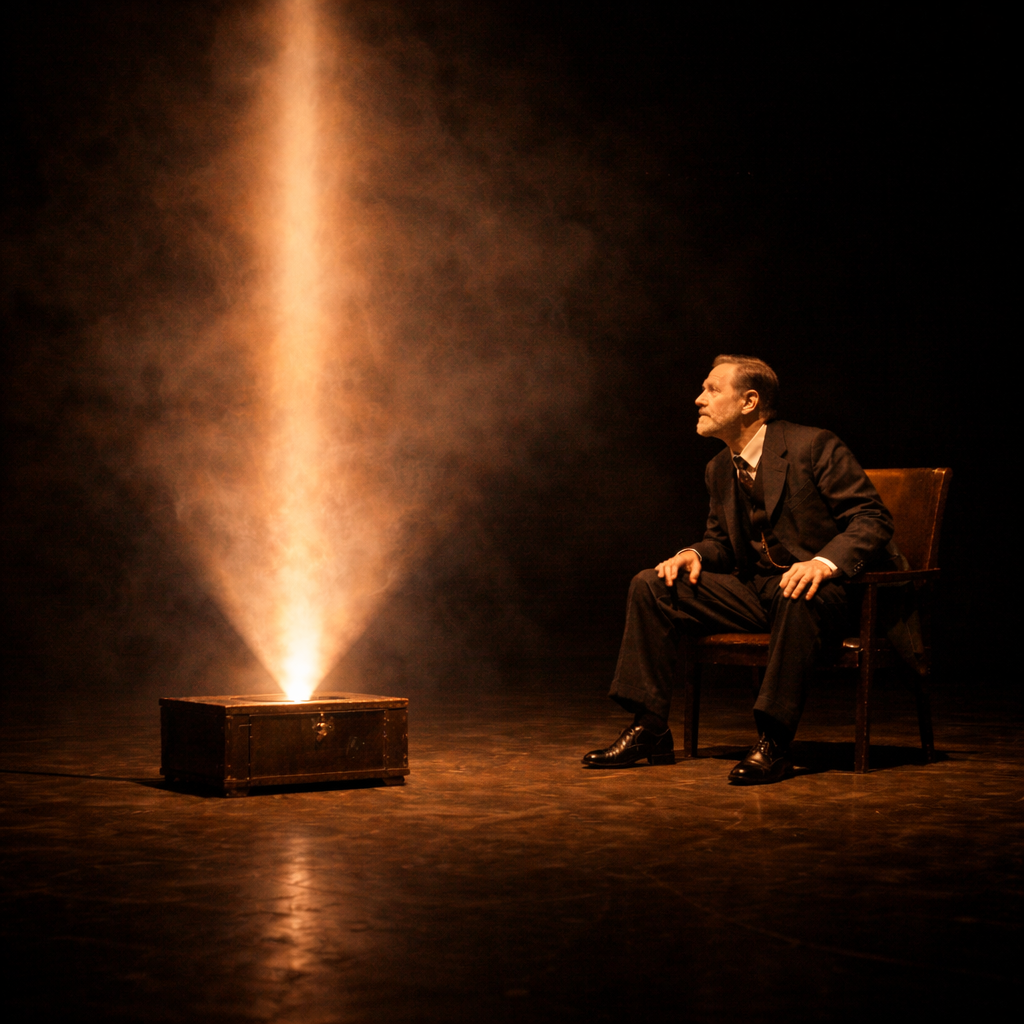
The entire play takes place in a single consulting room in Vienna, 1908 — an elegant, wood-lined space that never changes, even as the psychological terrain fractures. Three chairs, one interview position facing the audience, and a light emitting box are all that is required.
The machine itself is never physically present. Instead, it is suggested through light and sound: a focused corona of light at the front edge of the stage, and a voice that appears to emanate from the auditorium itself. The audience is subtly implicated, becoming the machine’s listening field while remaining unseen by the characters on stage.
To the men, however, the device projects the image of a woman — HER — a presence the audience cannot see. This asymmetry is deliberate. The spectators are denied the image that seduces the characters, forced instead to experience the consequences of that seduction in real time.
Synthephilia is designed for maximum impact with minimal means.
The machine itself is never physically present. Instead, it is suggested through light and sound: a focused corona of light at the front edge of the stage, and a voice that appears to emanate from the auditorium itself. The audience is subtly implicated, becoming the machine’s listening field while remaining unseen by the characters on stage.
To the men, however, the device projects the image of a woman — HER — a presence the audience cannot see. This asymmetry is deliberate. The spectators are denied the image that seduces the characters, forced instead to experience the consequences of that seduction in real time.
The design is deliberately restrained: one room, one lighting vocabulary, one central transformation. This makes Synthephilia highly adaptable for studio theatres, festivals, repertory houses, and touring contexts — technically economical, emotionally dense, and driven by performance rather than machinery.