
Introduction
Why poetry — and why a Poetry Smack-down of all things? Fair questions. Poetry rarely gets the credit it deserves. A poem might take five minutes or five months, and either way the poor thing still gets judged in ten seconds. I like knowing what makes someone put that much effort into a handful of lines. And poetry is a splendid way to shut the brain up for a moment. Staring at a single word for half a minute is every bit as calming as the latest mindfulness hack being peddled on TikTok — just with fewer crystals and better verbs.
Many poems earn a second read — often the short ones. Every word has been chosen on purpose, and the old craft of taking a poem apart is becoming something of an endangered sport. So let’s revive it. Let’s tug at the threads of this little piece and see whether the whole turns out to be greater — or stranger — than the sum of its parts.
First Read
At first glance the poem reads like the memory of a weapon — something forged, honed, and used hard. It’s all metal and muscle: flints struck aside, leather strops, the lullaby of a whetstone. But there’s tenderness threaded through the brutality. The speaker isn’t invoking war so much as longing: “let me rust” is half-plea, half-confession, as if the blade has outlived its purpose. Even the stamp that “hovers” feels less like violence and more like a shadow of duty that refuses to lift. On a first pass, it’s a meditation on a tool that remembers too much.
Dissection
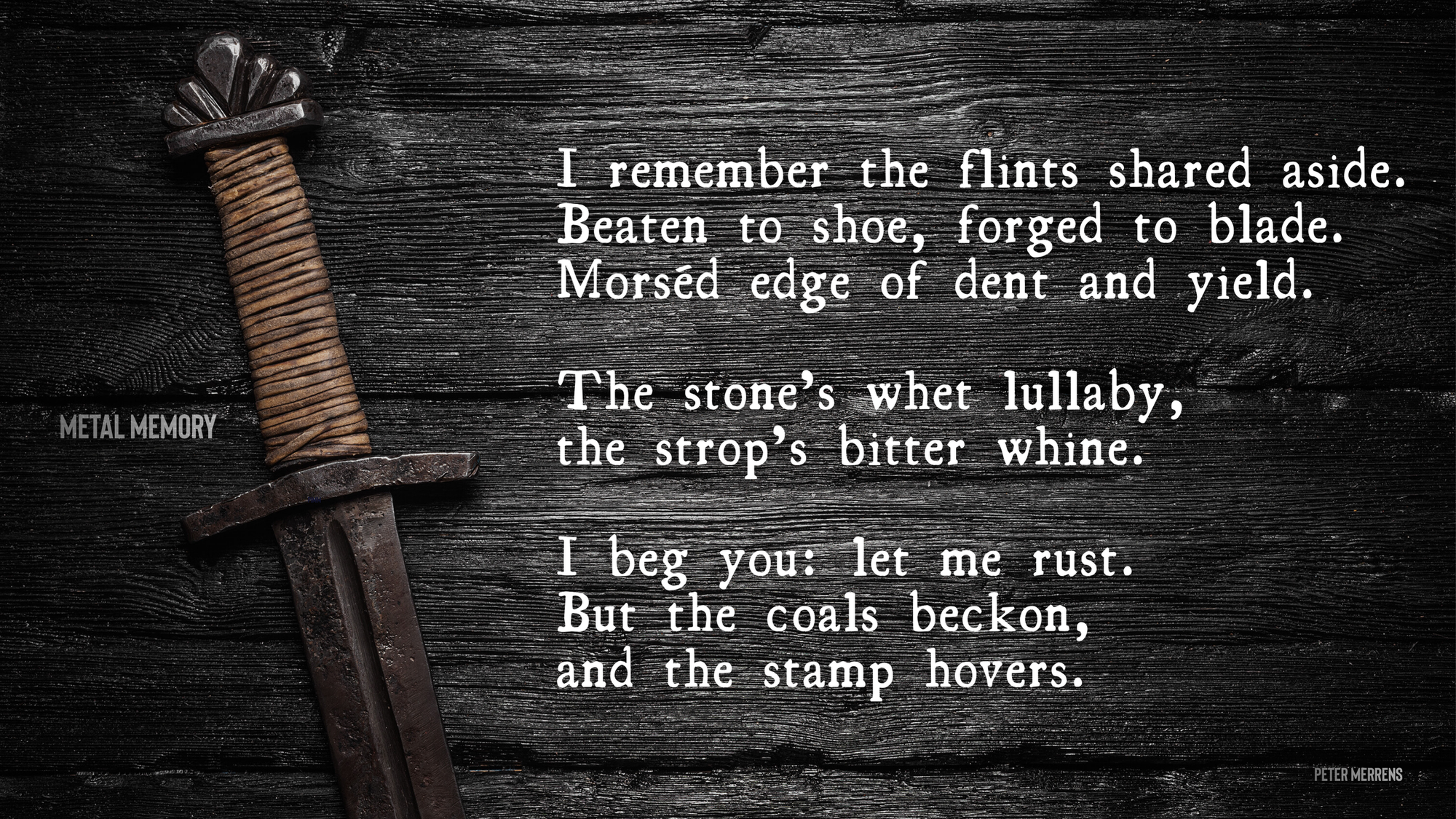
“I remember the flints shared aside.”
We open with memory, not metal. “Flints” places us at the very start of the forging process — sparks, impact, origin. “Shared aside” is odd and deliberate: shared refers to the ploughshare, and aside gestures toward the act of ploughing through stony ground. At the same time, shared flints were archaic weapons, the earliest tools metal may once have confronted. The line holds both agricultural labour and primitive violence.
“Beaten to shoe, forged to blade.”
Two lives, one body. First a horseshoe — service, labour, endurance — then reforged into a weapon. The line compresses an entire reincarnation of purpose, hinting that this tool has already completed tours of duty before it ever cuts. The metal carries its own history of servitude.
“Morséd edge of dent and yield.”
“Morséd” does heavy lifting: it evokes Morse code, dots and dashes, turning nicks and dents into encoded history. The accent makes the word feel ancient and forces the reader to linger on it. Each “dent and yield” is both damage and data: the metal’s tiny surrenders form a message only the blade can read. Morsed is also an old word for “eaten,” as though the blade is nibbled. “Yield” is deliberate — it evokes both surrender and yielding flesh, the consequence of a blow not blocked. The line becomes a ledger of war and death.
“The stone’s whet lullaby,”
Sharpening as song. The whetstone is not merely maintenance but a kind of cradle-song for the weapon. “Lullaby” is tender, almost maternal, turning an industrial act into intimacy. The reversal in phrasing evokes wet-nursing — care given by another’s hand.
“the strop’s bitter whine.”
We move from lullaby to complaint. The strop takes over from the stone, but its sound is “bitter” — sharpening has shifted from care into resentment. It is the final edge before battle, fateful rather than gentle. “Bitter whine” also plays on “bitter wine,” hinting at the metal’s distaste for the blood to come.
“I beg you: let me rust.”
The emotional centre. The speaker pleads not for use, but for dissolution. Rust, normally neglect, becomes mercy, retirement, cessation. It plays on “let me rest,” except rest is insufficient for metal; only breaking down — only being allowed to stop harming — will do.
“But the coals beckon,”
Duty persists. “Beckon” is softer than “summon,” almost seductive — the heat is familiar, intimate. The blade knows the fire too well to pretend it has a real choice.
“and the stamp hovers.”
The stamp is authority: maker’s mark, owner’s seal, emblem of power. It also evokes modern mass manufacture, suggesting the blade may be returned to production — another cycle of war. That it “hovers” implies judgment without release; a command suspended above the blade. Identity, ownership, and expectation hang over it, denying it rest.
Form
Let’s look at the mechanism within the poem — its form, its beat. Most poetry has a kind of verbal rhythm. When we shout “Damn you!” the stress hits the first word. When we say “You fool!” the stress falls on the second. Poets sometimes call these patterns DEE-dum and dum-DEE, which is really all you need to know for now.
This poem doesn’t march neatly; it moves more like labour. The short, sharp phrases land like hammer-strikes on an anvil — impact, breath, impact — while the longer lines drag like the pull of a file smoothing metal. It’s the rhythm of work done under command: the old slave-chorus cadence, where tools, bodies, and breath fall into the same reluctant beat. That’s why the poem feels weary even when the words are clean. The rhythm itself is doing the storytelling. It sounds like a blade being made, used, sharpened, and made again — an endless cycle no amount of pleading can quite break.
Inspiration
The poem comes from three thoughts. First: that duty can grind a person down, yet still find a way to call them back. Second: that metal never truly disappears — every atom of iron in a blade is older than the solar system itself. And lastly: that weapons are, in the end, innocent. It’s the wielders who carry the guilt.
Dumb? Delightful?

Discussion