
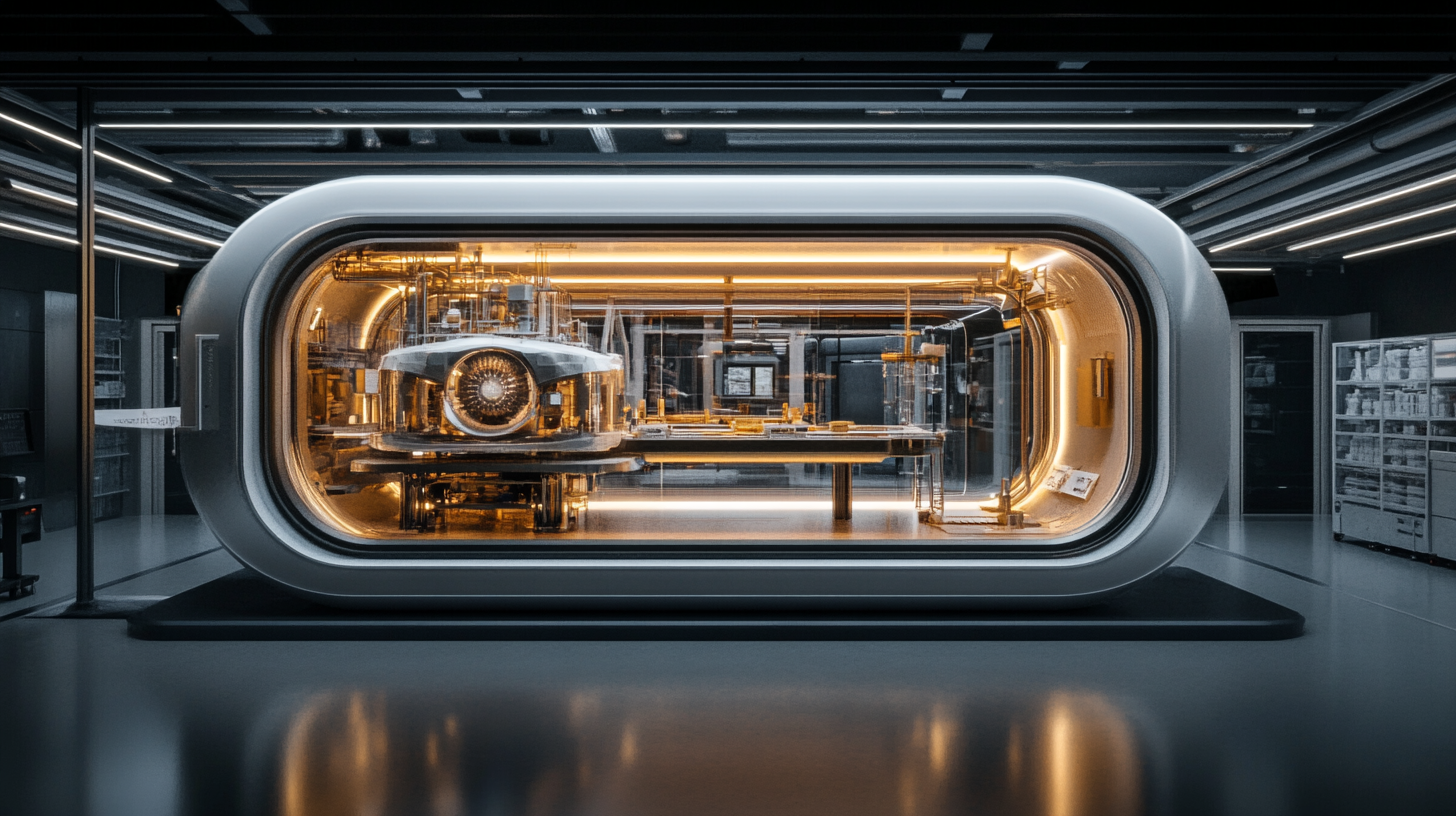
My new book Proximal God: Excursion explores the invention of human printing and its consequences. Writing hard science fiction means doing the work. Here is what human printing would actually require, and how close we are. I rate each step out of 5 as to how close we are today.
Every step is possible.
Scanning
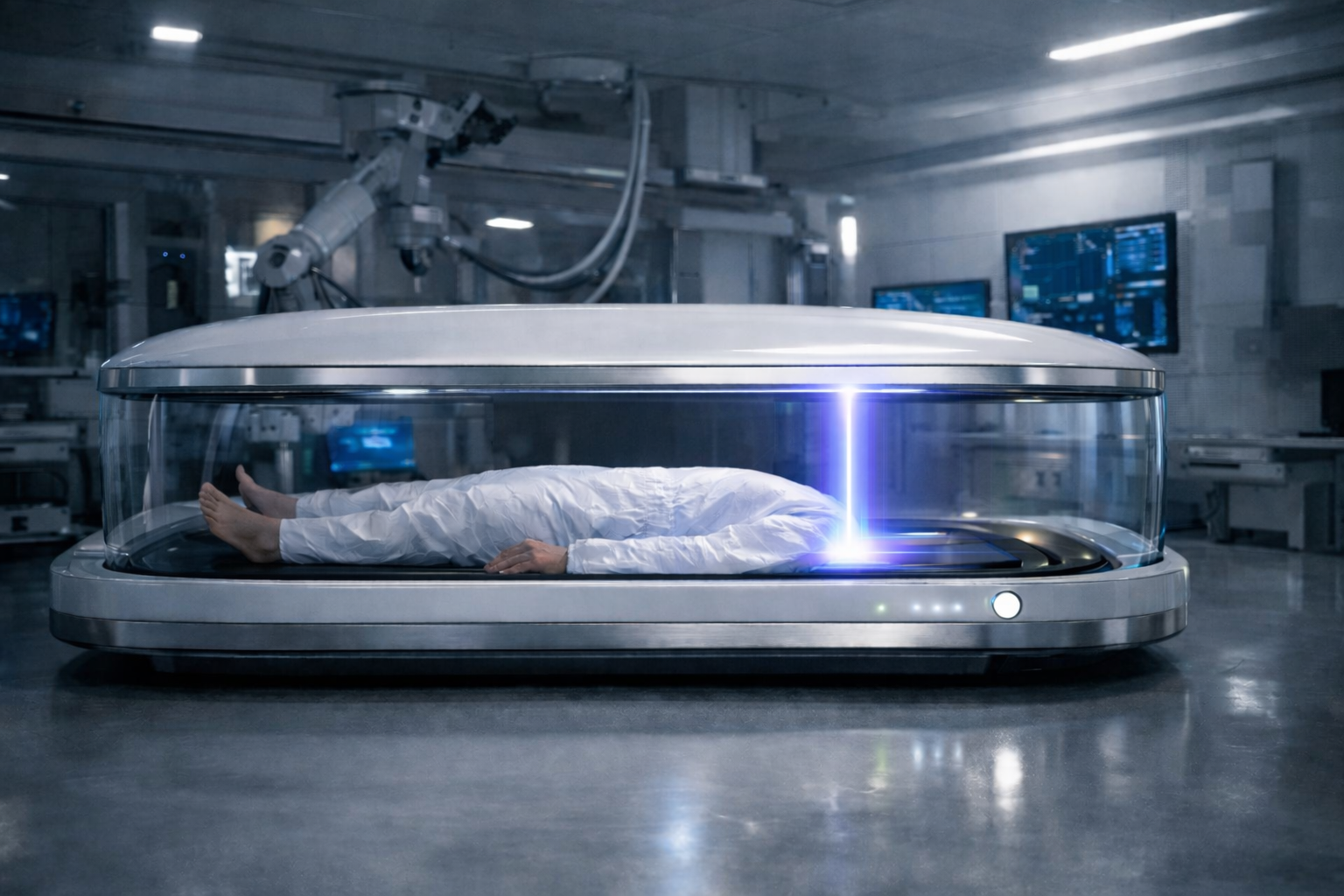
To scan a human you must kill it first.
A human is never still. Blood flows. Synapses fire. Villi move. You cannot scan a moving system. Committing to being printed means agreeing to be killed. Gas works. A gradual switch to hydrogen sulphide may reduce oxygen-linked degradation. Once death occurs, the clock starts immediately. 5
A septillion-hole cheese grater with a vacuum attachment.
We will never see through flesh well enough to analyse it at the atomic level. Imaging will always be indirect, averaged, and incomplete. If you want atomic truth, you must remove matter. The process planes away picoscopic layers, as scientists already do today, scaled to an entire human body. The scanner is a multi-layered grid, fine enough to pass between molecules. One layer advances through tissue; another shifts laterally, severing bonds. An upper layer siphons debris immediately, before pressure, heat, or chemistry can propagate. This requires filaments that detect what they contact and picotubes that remove material as soon as it is detached. If debris remains long enough to move, the scan has failed. 1
Heads wins.
This is time-critical. Gravity matters. Orientation reduces pressure gradients during removal. The human body is small where it matters most: the brain. The subject lies supine while the grid passes from head to toe, preserving the exact synapse pattern present at the moment of death. Neural activity does not stop instantly. Synapses continue to fire for minutes after clinical brain death. The scan waits briefly, allowing activity to collapse into a stable pattern before capture begins. 5
Data Storage / Transmittal
The Recipe.
Scanning analysis has to work on both exact and approximate atomic relationships. Active sites, ion channels, synapses, and regulatory interfaces must be captured exactly. Bulk tissue, structural proteins, and passive matter can be represented statistically. Molecules are identified and encoded once. After that, only position and relationships are stored. The data passes through the abrading gridwork, recording every atom or molecule, its position, and its linkages as it is removed. The raw dataset is vast. Galactic. Six-figure yottabytes. The data must be stored at greater density than the body. Solid-state atomic data storage. Compromises are not optional. 3
Let’s take some short-cuts.
Asymmetry, accumulated damage, bacterial populations, transient chemistry, and momentary molecular states are all choices. Limbs can be mirrored. Capillary networks averaged. No gall bladder. No appendix. No hair. No intestinal flora. Muscle tissue averaged to an optimum. Bone material made consistent. The list is not endless, but it is extraordinary. If you can be printed once, it can be done again. You are not storing for durability. You are optimising for function over a defined duration. 5
A very wide fire-hose.
Your recipe must be transmitted between scanner and printer. Get a synapse wrong and you may forget your name or how to add. Get a muscle fibre wrong and it averages out. DNA corruption drives cancer and ageing, but you do not transmit DNA as trillions of repeated atoms. You transmit it once, as a molecular definition, then as hierarchy and placement. Bandwidth is the choke point, but not impossible for short connections. With current tech the numbers are prohibitive. Do the math. Six-figure yottabytes in minutes means octabit-scale throughput. A trillion parallel fibres, miniaturised like the picoscopic grid, means each fibre must carry a petabit per second. We hit petabit-per-second class rates over fibre in the early ’20s with extreme multiplexing. 4
Printing
That’s one hell of a 3D printer.
This is the fun bit. It’s also the bit glossed over in every piece of media. Starship Troopers’ macroscopic weavers. Star Trek transporters. Force-grown clone bodies. And only the author knows how Mickey 7 was printed. None of them touch the mechanics. Whatever happens, you need a printer with at least 22 atomic element cartridges. This is still only a 3D print. Nozzles won’t work. We need atomic deposition and manipulation. That is possible today at tiny scales, but it would have to operate at an extraordinarily fast rate so structure does not collapse as it is printed. Delivery is the other half of the problem. If we can build tubes that vacuum away debris and deliver feedstock cleanly, the rest becomes engineering. Today, electrohydrodynamic (EHD) printing operates at ~50 nanometres. Atomic scales are 0.1–0.05 nm. We need to go 500–1000× smaller. 2
Can I play with your femto-lego?
At first glance molecular assembly looks like the hard part. A femtoscale crochet symposium. It isn’t. Atoms want to lock together. Our job is to deliver the atom and get out of the way. The printer does not construct molecules. It initiates assembly. Atoms are delivered into constrained fields at controlled energies and bonds form automatically if allowed. Where geometry is critical — active sites, ion channels, neurotransmitter receptors — femtosecond timing matters. You trigger bond formation at the right instant and step aside. Everywhere else, chemistry self-assembles faster and more reliably than any machine could force it. This already happens today in surface chemistry, catalysis, and atomic manipulation. STM tips trigger single bond formation. Catalytic surfaces enforce geometry. Molecular beam epitaxy grows ordered structures one layer at a time. 3
It’s ALIVE!
Will the printed human be alive? No. It will be in the state scanned. Full of the wrong gas. The military already experiments with gas-induced suspension to keep the critically injured inert until they reach a surgeon. The principle is known. In theory: a little gas, some judicious current, et voilà. 5
Fact then — So when?
Fifty years without AI design. Ten — with.
Let the games begin.

Discussion