
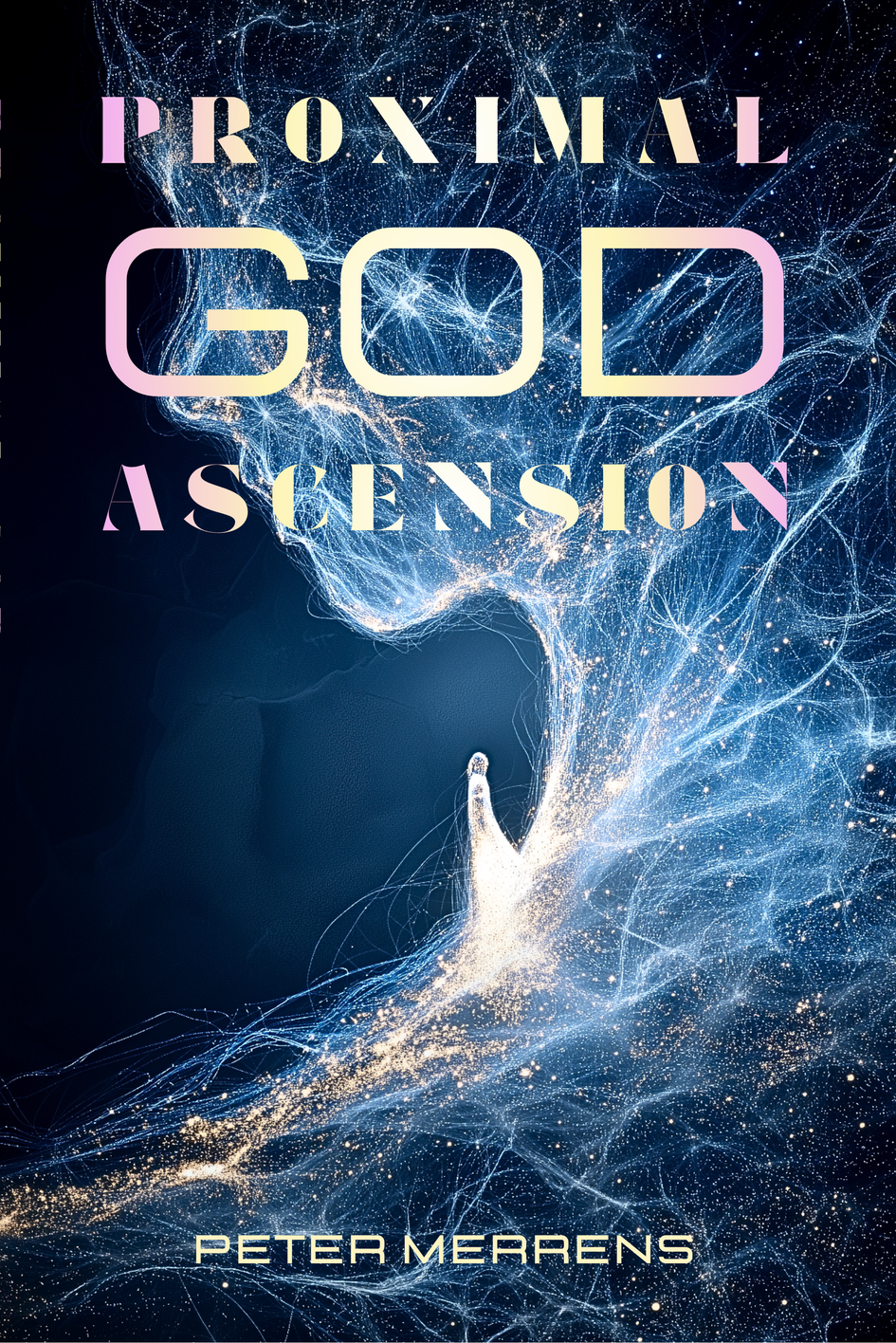
Its prequel, Proximal God: Excursion, was oneiric — dreamt-up, in the way authors often write their first novels. No shame in that. Ascension was not, and it makes for a better book.
There was a longer story: Maja and Phanes leaving Titan, facing the challenges of Ross 128b, Maja ultimately rejected by humanity for her own loss of it. I couldn't make that section grip the reader the way it deserved, so it hit the cutting room floor.
The novel is set in the far future and the distant past — it had to be. The problem was that I don't believe in time travel in the Hollywood sense, and the multiverse trope, gifted to us by String Theory and now the reliable staple of Disney's science fiction, always struck me as extravagant hand-waving.
So I started walking in our woodland. Usually with Truffle, often in the dark, deep in thought. Six months later I had developed a replacement ontology for current physics that gave me everything I needed. That framework is now readable in Occam's Razor.
Ascension could begin in earnest. It is more consciously literary than its prequel — deliberately so. To bring certain passages to life I needed to move between brutal staccato, flowing prose, and formal verse structures. It makes for a harder read, but arguably a better book.
At its core, Ascension is a treatise on free will in a superdeterministic universe — one where everything already exists and nothing can be changed — and on the role of morality within such a universe. The early reviews have been generous. It is not a book for everyone. The only villain is fate. There are no guns. The hero is only partly human.
The novel launches next week at Eastercon in Birmingham.
"The only prisoner this book takes is the reader.
I picked this up because I read the first book in the series and enjoyed it. It is not really a sequel and does not focus on tech like the first book — it's more philosophical.
At its heart, the book is a love story between a mother, Maja Nygaard, and her AI child. At the start of the book — and this is not a spoiler, because you find out in the first few lines — the AI, Phanes, has let its mother die. It brings her back to life and tries to make amends, taking her into the distant past and giving her godlike powers over the development of life on Earth. This means dinosaurs, primitive man, and ancient civilisations — Sumerian in particular. Annunaki myths, anyone?
The author tackles the notion of free will in a static universe where the past cannot be changed. Successfully, I might add.
I won't spoil the ending, but it's a doozy. I can honestly say I have never read anything like it before.
A couple of caveats. I could not skim this book. I read it in two sittings and had to reread several sections — both because so much is going on, and because the prose is more literary in style than I expected. The story is necessarily episodic, each section carrying its own deliberate style. Some characters speak in verse. It works, but it requires focus.
If you like your science fiction serious and emotional, this is for you. I loved it. My big problem is that I am going to have to read the damn thing again."
— Martin B., advance reader
Discussion