
How did we learn to live with this good graciously green planet, Little Ones? I’ll tell you the story but you must remember that it happened a long time ago when the world was cool and dry.
There was a perfectly average man, so let’s call him Joe. We know that he taught English. And he was doing what English teachers did during their lunch breaks if it was sunny. He was going to his favourite park bench wearing his “coolest sunglasses in the world” with his head held high in the sunshine. As he walked, he took bites from his ham and egg sandwich. He should have waited to eat his lunch on the bench but his stomach was rumbling, his willpower was low and his wife had made the sandwich with a delicious mustard mayonnaise.
As he turned into the park, he saw a quaint booth set up at the entrance. Just a small table covered with crusted pots, pans and unidentifiable kitchen equipment. Was this a food stall? He had not yet digested his sandwich so his brain was still telling him to eat.
Easy to understand for all of us, I am sure.
Sat behind the table, was a slim old man with dark sallow skin and huge bags under his kind, rheumy eyes. He looked malnourished and we all know that is a bad thing, don’t we? The old man was on a small folding stool, leaning back on what appeared to be an ancient steamer trunk on its end.
On the table was a handwritten fold-up chalkboard sign with graceful flowing script. “I will amaze you for £5 or pay you £1.”
Now, £1 did not buy much anymore but Joe might have been able to pick up a packet of mini-mints so what did he have to lose?
He was either going to be amazed, which was worth the money, or he was going to get some free mints.
Joe stepped towards the table and the old man straightened in his chair. His wizened face splitting into a welcoming, though long-toothed, smile.
“So, amaze me and I will give you £5.” Joe said.
“My good friend,” said the old man. This was a little presumptive but Joe didn’t mind.
“You have to forgive me but I have grown cautious. You see this box?” The old man gestured towards a small wooden box, ornate with embedded bits of crushed egg-shell.
“If you put your money in this box, I will add my £1. Then if I fail to amaze you, you may take back your £5 and my £1 at the same time.”
Joe lifted the lid of the box and saw that inside, sat on the velvet lined base, was a lonely one pound coin. He took a fiver from his “best father in the world” wallet, folded it into the box and closed the lid.
“Thank you my dear friend. Prepare to be amazed.” The man leaned around to his steamer trunk and split it open. Inside were several shelves filled with ancient glass jars of odd ingredients. This did not look promising if Joe was going to be able to eat the ‘amazing’ thing. He had hoped for some fudge or maybe some caramelised peanuts, but now he was not so sure. Some of the ingredients looked like crystals or parts of insects. Very unappetising, Joe thought.
The old man’s hand flew between jars and mixing bowls. He used a gas torch to heat a small ceramic bowl into which he carefully dropped substances using tweezers, tiny ceramic spoons and pipettes. The bowl was smoking and steaming at various points. At one time he held a chipped glass jar in his hands and looked forlorn. Joe could see that the jar was almost empty. It looked from where he was standing as though it contained a few iridescent shards of what looked like Australian opal. The old man used a long pair of tweezers and clasped one of the pieces of stone. He held it up to the light. The stone sparkled, its colours shifting and refracting in the afternoon sunlight.
“Is that an opal?” Joe asked. His wife had a birthday in October and as her birthstone was opal, Joe had given her a pair of earrings with two pitifully small opals set into the silver of the jewellery.
“You are very perceptive, my good friend. Many people think that all opals are a type of mineral but I am going to prove to you that some are something else entirely.” With that, the old man dropped the shard into the smoking bowl.
Joe kept checking his watch, then, after about 15 minutes the old man raised his head and said. ”It is ready!”
“Is what ready?”
“Prepare to be amazed.” The old man replied. He picked up the small, now just warm bowl and tipped it onto the table. Joe was baffled. Sitting on the centre of the table was a small blob of translucent, colourless goo. It quivered for a moment, more solid than a water filled balloon but less dense than a soft cookie.
“What is it”? Joe asked.
“Oh… silly me. I forgot to tell you. It is a pet. I have made it for you.”
“It’s not a pet, it is a blob of goo. Pets are sentient animals.” Joe said this knowing that when he was young, there had been a craze for pet rocks. For at least a year, children in his school had painted small eyes on various pebbles and carried them around like babies. Some had collections they nursed in egg cartons. One young girl had replaced her rock with a slightly larger stone every few days, in an effort to convince everyone that her pet was growing.
“Ah, my dear friend. This one can be. It is but young. Right now all it can do is just… be. Pick it up, let it feel the warmth of your hand.” Joe was dubious. He did not want to touch it. It looked like a semi-transparent slug with no head and no tail. But he didn’t want to look cowardly so he picked the thing up. It was warm to the touch, probably because it had just been cooked, Joe thought. The goo quivered in his palm. Joe frowned. Had he just felt it move? No, it couldn’t be. It must have been shaking in reaction to the movements of his fingers. He placed it back on the table.
“It’s just a piece of jelly.” Joe scoffed. “It’s not a pet.”
“It is yet young. Just a baby. Give it time, take it home, feed it, it will grow!” The old man insisted.
“I’m not taking this dead headless slug home with me.” Joe snapped. The old man looked defeated. He slumped back in his chair and his eyes brimmed with tears.
“I’m sorry, I did not mean it like that.” Joe said, feeling guilty for having upset the old man. “You can keep my £5. You have amazed me.”
“You do not believe me.” Said the old man, shaking his head. No-one believes me. It is alive. If only you would give it some love and time.”
Joe was backing away from the table.
“Wait!” Called the old man. “Just watch this!”
Joe leaned forward. The old man took a pair of tweezers and placed a rice grain-sized piece of something green beside the slug.
“You must eat, little one. Show my good friend that you can.” The old man implored. The blob was unmoved. Joe watched for another few seconds then just as he was about to turn away, the green morsel vanished. The translucent thing made a tiny quiver.
“You blew it away!”
“No! I promise you that the piece of algae was eaten. They move very quickly. By all that is right and good, I swear to you that it is alive!”
Joe was skeptical. He took one last close, lingering look at the small blob then shook his head and turned away to return to the school. He left the frail old man slumped over the table, his head resting on his forearms.
All afternoon, he was distracted by his memory of the old man and his earnestness. But what puzzled him the most was that when he had looked at the small blob that one last time, he thought that he could see a tiny speck of green inside the thing. As the afternoon wore on and the more he thought about it, the more he wanted to be sure.
He did not have any duties after class so he hurried to the park. The table was still there. The old man was asleep with his head in his arms.
Joe looked around the park to see if anyone else was watching — it was empty.
He stepped to the table and coughed into his hand. “Ahem!”
The old man didn’t move.
“Look, I’m sorry about earlier. I was rude. I did see something inside the blob. Please could I have another look?”
The old man stirred. “Ah, it is you my dear friend. Alas, I am sorry to say that it is no more.”
“You have thrown it away?”
“Oh, no, I would never do that. I don’t like to do it, but there is a way to… recycle them. Only when they are very young. I have very few pieces left. You were my only guest.”
He rubbed his eyes. “I have lived a very long time. Once or twice someone has believed me. They never kept them. All the babies want is a forever home.”
He looked at the jars in his trunk and sighed. It lasted a fraction longer than a natural sigh, and halfway through he glanced back at Joe.
“I don’t know why I continue. I had such hope for this world. I shall try somewhere else tomorrow.”
“I am sure that I saw a green speck inside the thing. Was that eaten or was that a trick of the light or a speck of opal?”
“Oh yes, it was eaten. They move very quickly if they have to. They then absorb the food at whatever speed they need to sustain themselves. They make no unnecessary movement. It is very frustrating.”
“But if they are alive, why do you not keep it like a pet.”
“They take a lot of care and they grow very slowly at first. It is almost quicker to make up a new one from… ingredients.” The old man tapped on his oversized suitcase.
“If I paid you for your time, would you make me another one, for a friend this time? Not here, at the University… tomorrow. I’ll pay you a fifty pounds.”
The old man blinked. “Well, I am not sure…”
“One hundred pounds. Just to make one for my friend.”
“Will she keep it?”
“I promise you that if she does not, I will. You have my word.”
“Then I will.” The old man nodded with a resolute expression. “The price will be five pounds.”
When Joe had been a student himself he had had an enormous crush on a dainty ginger-haired girl in his biology class. He had tried to get himself noticed but she was quite brilliant and he had been such a goof. The girl, Chloe Mansion, had told Joe that he was “sweet”. That had been it, the word was fatal for a potential relationship but they had stayed friends. Joe was now married and a much admired Secondary School teacher, Chloe was a twice-divorced, full-tenured Professor of Molecular Biology at illustrious nearby University. Joe still yearned to impress Chloe. Chloe thought of Joe as an old friend from simpler times and summer days. Joe was still trying to impress Chloe but even he realised that this was a risky stunt.
The next day, Joe and the old man were in Chloe’s office. The walls were covered in awards and certificates, there were fresh flowers in a vase on the desk and Joe thought that Chloe was looking relaxed and beautiful.
She greeted him like the old friend he was.
“I only had a few minutes to spare in between lectures but why don’t we meet for a coffee another time?”.
Joe had helped the old man bring his equipment and everything was ready for the alchemy. Once again, the old man prepared his ingredients and dropped things into the small bowl. More smoke and steam that had Joe looking at the smoke alarm with concern. Chloe watched the old man with an odd expression of curiosity mixed with sympathy and occasionally asked to look at the bottles. She shook and sniffed at the contents, sometimes she wrinkled her nose, and once even gagged at the brown fumes rising from an unstoppered bottle.
The blob was ready. The old man tipped it onto the desk with a celebratory gesture, his performance complete.
“What is it?” Chloe asked.
“It’s a pet.” Replied the old man. Chloe looked dubious and glanced at Joe.
“No, really Chloe. I’ve seen one move and eat.” Joe said.
“Show me.” Chloe replied.
Without a word the old man placed a tiny grain of dried algae next to the blob. They waited. Nothing happened.
“I don’t understand.” Said the old man. “Maybe it is because we are indoors or maybe it is nervous.”
Chloe scoffed, although she had a smile on her face. “Joe, it was lovely to see you. I am serious about that coffee but I have work to do. Thank you for… this.” She pointed to the blob. Joe was mortified but they said their goodbyes.
Back on the doorstep of the building, Joe turned to the old man. “I’m sorry that did not go any better.”
“It went wonderfully.” Said the old man. “She didn’t reject the pet.”
Unknown to them, the moment Joe and the old man had left the office, Chloe had slipped on a latex glove, picked up the blob between two fingers and tossed it into a pedal bin in the corner of her office.
And that, little ones, is the last time Joe saw Chloe for a while but it is only the beginning of Chloe’s story. I will tell you this, Joe dreamed of Chloe at night, isn’t that exciting? Chloe on the other hand dreamed of scientific fame.
The next day, Chloe opened the door to her office and went completely still, like an animal waiting for food to come to it.
Because there, right in the middle of the floor, was the blob.
Only it was not quite the same blob anymore.
Yesterday it had been colourless, like a piece of jelly that had forgotten how to be dessert. Today it was a pale, timid green, exactly the colour of the sad iceberg lettuce she had thrown away from her store-bought bacon, lettuce and tomato sandwich.
Chloe bent down and stared at it. Was this a prank? How did a thing with no legs climb out of a bin? And why was it green now, like it had been thinking about salads?
She did what people like Chloe had always done when the world misbehaved. She put on gloves.
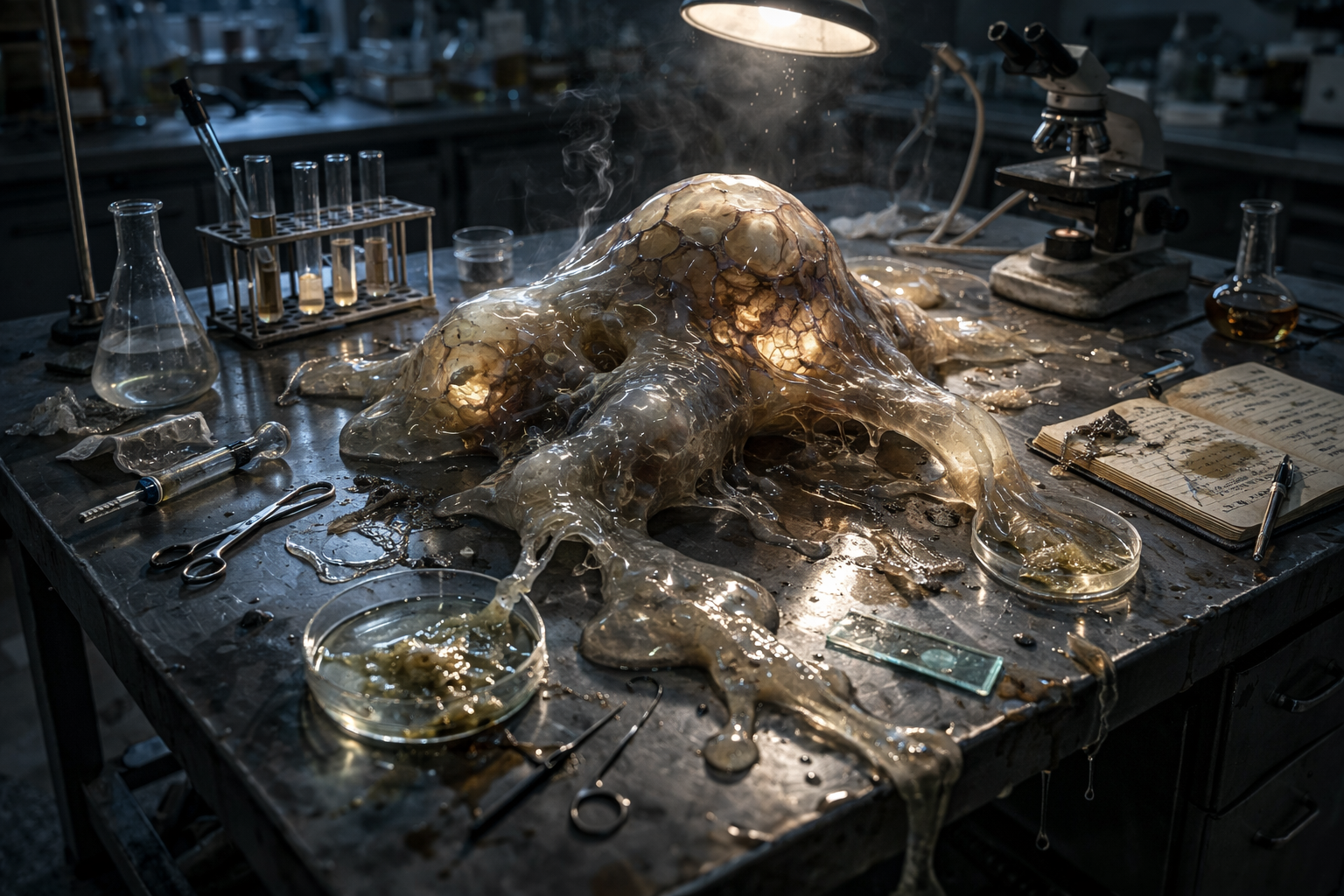
She slid her hands into rubber and picked the sluggy critter up between two fingers, as if it were something that might leave a mark. Then she carried it into the lab next door and set it on the bench.
Chloe shone a bright light at it. She peered through a magnifying glass. Just under its skin she could see tiny shreds of green. Not stuck on. Not smeared. Inside. And the green did not sit there politely. It faded. It sank. It dissolved inward, very slowly, the way a child let a sweet melt on their tongue because they wanted it to last.
“That,” Chloe murmured, “is a process.”
She found a petri dish, a little clear saucer with a lid, and she tucked the creature inside. Then she went hunting for food, because she was a grown woman and that was what grown women did when they found something alive. They fed it so they could watch what happened next.
In another part of the lab she had a moss sample from a different experiment. She teased it apart with tweezers, plucked off a shred, and laid it beside the blob, just as the old man had done.
For a moment nothing happened.
Chloe waited, holding her breath without noticing she had done it.
Then the moss vanished.
Not slid away. Not fell off the bench. Vanished, like a coin in a magician’s palm, except there was no magician and no applause.
She snatched up her magnifying glass and leaned in until she was almost nose to dish. Under the surface of the creature, right where the moss had been, a little dark green speck had appeared. It dissolved as she watched, trickling inward. Dinner travelling through a body.
Chloe sat back very slowly.
Over the next few days she did what scientists did when they smelled a prize. She poked. She prodded. She measured. She photographed. She frowned, as if frowning was a tool.
And then, Little Ones, she did the thing you were not supposed to do to pets.
She cut a tiny piece out of it.
The creature did not scream. It did not bleed. It did not even seem offended. It simply accepted it, as if it had never believed in ownership in the first place.
Chloe put the shaving into her clever machines. One of them told her the creature was mostly silicon-based. Silicon was what you found in rocks and in chips and in other things that were not meant to sit in a petri dish and eat moss.
It had no DNA. No little spirals of instructions. No tidy rooms with walls. It seemed to be one continuous body full of a strange substance that digested whatever touched it.
Under low magnification its skin looked complicated, layered, patterned, almost beautiful in the way of things built for one purpose only. But there was no head. No tail. No obvious front or back. It was simply blob-shaped.
The only thing Chloe could say with proper certainty was this. It was almost impossible to destroy.
She tried crushing it. She tried burning it. She tried dissolving it with every nasty chemical she had tucked away. It would not melt. It would not char. It would not give in.
When frozen, it went hard and quiet. When thawed, it softened and carried on, as if nothing important had happened. When starved of oxygen, it did not panic or die. It simply became still. Under fluids it behaved as though it had been in air.
The little sample she had taken became another creature all by itself. Like a cutting from a plant. If she did not feed it, it did not grow. If it came anywhere near moss or vegetation, it incorporated it. Took it in. Kept it.
Eventually Chloe encased that smaller piece in a block of resin, clear acrylic, like amber for impatient humans. That stopped it moving. Chloe felt satisfied. As far as she was concerned, it would wait there for a few thousand years until the plastic grew tired and cracked.
Now, the eating.
The eating was the strangest part, because it happened too fast to see properly. One moment the food was beside it, the next it was not. Chloe caught it on camera and found the trick. A blindingly fast extrusion and snap-back, like a chameleon’s tongue. Not a mouth. Not chewing. Reach and keep.
And that was how it moved too.
It extruded itself in the direction it wanted to go and pulled the rest of its body after, like someone hauling a heavy blanket across a floor. The speed of it only became noticeable once her “pet” had grown to the size of a small mouse.
That was when Chloe stopped thinking she was watching a curiosity and started thinking she was holding a prize.
Chloe was already well into the research she hoped would win her a Nobel Prize, which had never had anything to do with nobility, Little Ones, when the next development took place.
One morning a colleague in the same lab asked if she had noticed anyone interfering with his experiment.
“Interfering how?” Chloe asked.
“I had a dissected rat on the table last night,” he said. “Pickled. Not going anywhere. This morning it looks like it has been through a blender. It is mostly still there, but it is hard to tell. Someone has chopped it into pieces.”
“That’s awful,” Chloe said. “Who would do such a thing?”
“Precisely who?” the researcher replied. He was indignant. He was suspicious. He was human.
The moment passed, and Chloe went back to her own bench.
Her “pet” looked the same. That was the problem. It always looked the same, right up until it did not.
She weighed it. It was a few grams heavier than it had been.
She did not cut away another sample. Instead she placed it under a low-power microscope and adjusted the focus.
The inner layer of the skin had changed. Fine branching threads ran just beneath the surface, delicate and recursive. They looked like nerves. They looked like dendrites. They looked like something that had learned what a rat was for.
Chloe sat back slowly.
The creature had fed on the rat. It had not taken meat for strength. It had taken pattern.
Chloe set up a camera and decided to feed it properly, so she could watch the process frame by frame. She waited, chewing at her thumbnail.
It happened too quickly to see.
The camera clattered to the bench when her hand knocked it. She did not notice until later.
When she replayed the footage, the extrusion was no longer a simple reach. For a fraction of a second it formed something jointed and grasping. One frozen frame suggested a tiny skeletal hand.
Chloe put the creature back in its perspex box and secured the lid with a rubber band.
It was the last time she ever saw her “pet.”
When she returned the next day, the box was empty.
Chloe was distraught. Who wouldn’t be, and so she called Joe for the first time. Perhaps Joe left his wife, perhaps he didn’t. It doesn’t matter. Little Ones, this is not their story;
It is the story of the critter.
Let’s give it a name. Bob is as good as any. Bob the no-longer-so-little blob. Bob escaped the lab, armed with everything that first rat knew. Which wasn’t much to be fair because it had been dead for some time and was pickled. But rats were instinctive little devils and Bob felt that every time it budded to create an offspring, it gave away a little intelligence so it began to look for larger minds to assimilate. Cats were the next target, then dogs and all manner of livestock. Can you imagine assimilating an elephant, Little Ones? It must have been quite a thing.
Bob’s offspring developed and found their own creatures to absorb and learn from, and the rest, as they say, is history.
Humans, to the last one, had the best brains to absorb and they were so easy to eat because they just stand there and shout. So in case you are wondering what happened to Joe and Chloe, you all have a little bit of them inside you which is why we remember fragments of their story. Humans like Joe and Chloe gave us the ability to speak and form an advanced society although we needed little of what they had built.
There is plenty of grass to graze and shrubs to munch and there always will be. We don’t miss the humans because we have them inside us. We do miss some of the other colourful animals though, they were very pretty, but never mind, little ones, this good graciously green planet is ours now and has been for longer than man ever existed.
What’s that Little One? Am I Bob? Goodness no. Bob divided so many times, we are all Bob’s buds. I’m the little bud who was encased in resin. I was freed months later by Chloe when she lost Bob and I have to confess. I did eat the tip of her left thumb, and a bit of her elbow. And some scalp. Oh! And the tip of her nose. I was very hungry.
But we don’t want to talk about that Little Ones, go out and graze. If one of you should find a worm, gulp it down but if you find a mole — well — just make sure you share its brain between you. You are going to need all the sense you can eat.
Discussion