
Caroline took a last glance at herself in the mirror. Perfect. Braced for another afternoon of sales. She was fortunate enough to have landed a prestige gallery role in Wickhams, London's premier dealer in Contemporary Art. She had spent the afternoon rehearsing an explanation of their newest acquisition, a composition of dead butterflies, beautifully arranged in a geometric tableau. The piece moved her in ways she was learning to understand. Its colour composition, the way it refused to apologise for its own extravagance, its precious brutality.
She straightened her Zara blouse and stepped into the gallery space.
She pursed her lips when she saw the unfilled space on the plinth. An African tribal mask carved of dried sickle cell blood had sold this morning. The buyer had loved the story of how the face was only smooth because it was unbitten. Only after the sale did the buyer stroke his fingers over the smooth surface.
A man stood facing the butterfly piece. She hadn't heard the bell — she must get that repaired.
His face was no more than two inches from the almost invisible museum-grade glass. He was utterly still. She was worried he might touch it, or worse, smear it. A few steps and she was behind him.
"It's stunning, isn't it?"
He didn't reply. He turned, his expression quizzical. The suit he was wearing was beautifully tailored, clearly handmade, but in a hyper-modern style that paid homage to the 1950s. Fine, slightly shiny blue wool that pulled at her eyes as she sought detail.
"I'm not sure. Why don't you tell me about it?" His accent was that of a Frenchman who had lived for decades in America — decades that did not show in his skin.
She bit the inside of her cheek. She must remain calm and reflective, not too pushy. Mirror his mood, find his level.
She was in two minds as to whether to use the name. She decided against it. If he did not recognise the work it would mean nothing. The butterfly paintings had been his signature for two decades. Every one slightly different, some set on photographic backgrounds, some starkly poised on white. The last had gone for three hundred and forty thousand at Christie's. She still didn't know what she was dealing with. Collector, she hoped. The suit suggested it.
"I'm sorry, Mr… Mr… ?" Her hand hovered for a shake.
He did not move. Merely pursed his lips then smiled through her, as though at a child caught in an act of precocious genius.
"Well…" She swallowed. "Life is so precious that we fail to overestimate the value brought to mortality by its contemplation. Death has a price for us all, but it is impossible to understand subjectively. We must experience its display…"
She studied his face. The smile had not moved but he was watching her lips as though reading her words. Was he hard of hearing?
"We cannot understand. No, sorry. We cannot appreciate our lives unless we witness mortality itself. It's more than value, it is a profound reregistering of our experience. Every butterfly here has made a sacrifice. Each wing a moment for us to absorb. The colour reminds us of the beauty of past days and the geometry of those to come… yes, those to come."
His gaze had not shifted. Did she have something on her face? Was her lipstick crooked? Her back prickled. A sale in her first week, that would make her reputation.
The doorbell announced Howlett, the gallery owner. Another pair of eyes focused on her delivery.
"Did he pin the butterfly himself?"
She turned. It was the old man who had asked. His accent, soft French with an American overtone. Old fashioned, old money. Why would he ask such a question? Of course not.
"The artist guides every hand. Such delicate work is only trusted to master artisans. Every wing is so precious that it is like laying gold leaf. Can you see here, this array of speckled beauty, these are Metalmark butterflies. Apo… Apodemia mormo langei. The rarest of the rare. But the value is not in their rarity, it is their journey, the precious ephemerality. Every wing a journey through teenage pain and adult joy. This work is a cartography of our existence, unparalleled in its reflective insight."
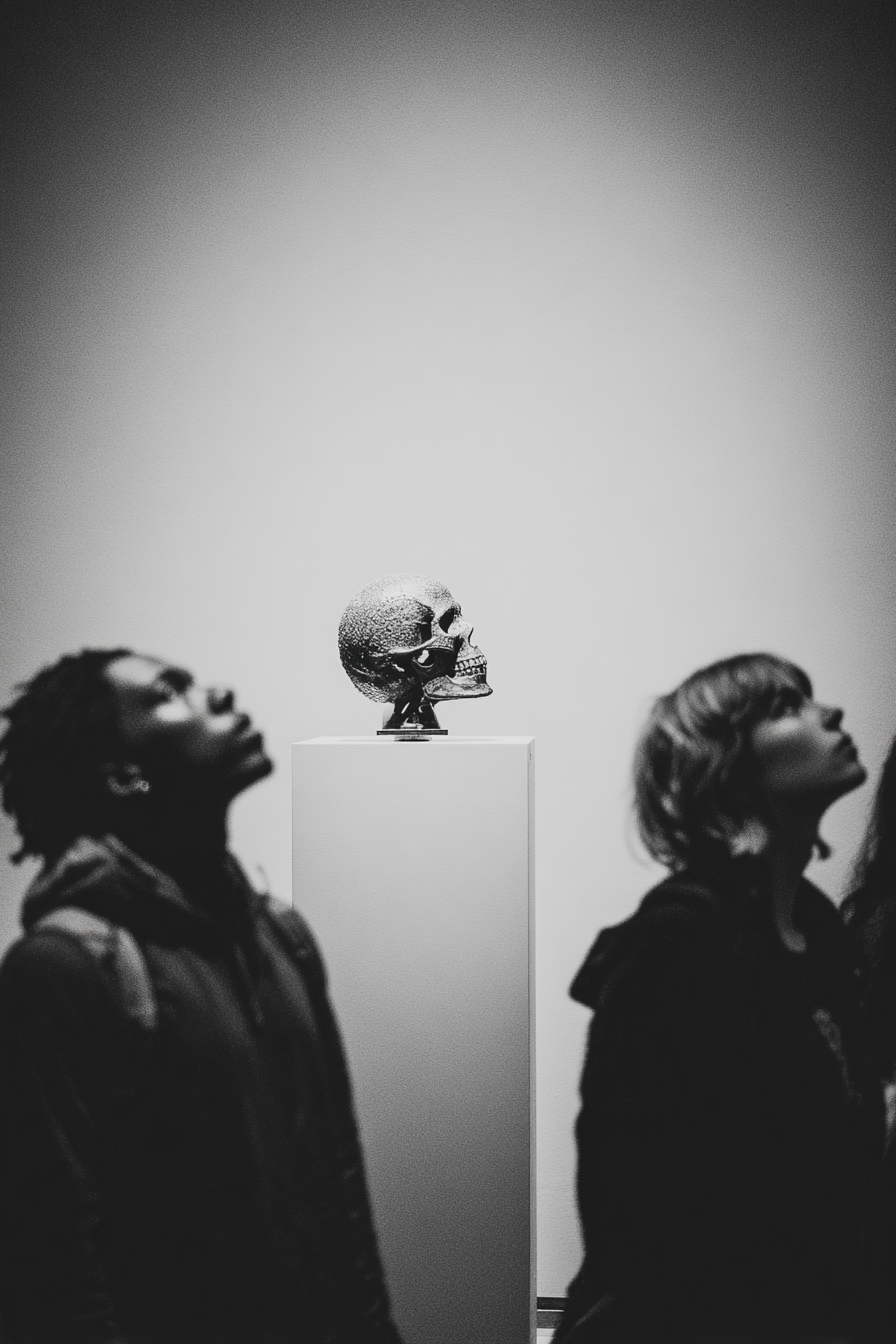
She had lost him. His eyes had gone. She glanced at Howlett. He nodded briefly. The man had stepped across to their centrepiece but she had not heard him move. The empty plinth where the mask had been caught her eye for a moment. There it was, just at waist height, the pattern of diamonds encrusted in the forehead catching the light. Memento Mori Redux. They had it for two weeks on concession. Could it… would he?
"Ah, Memento Mori. The jewel in the crown of his entire catalogue. Already priceless. Only two made. This is the second piece. Some would say the more refined. See the way the diamonds follow the sculpted lines of the inheritor."
"Sculpted?" The man was cocking his head.
"Well… no, not literally. I mean the angles in the skull's handsome presence." She was losing the thread. "Once again, the artist has taken his oeuvre to its ultimate conclusion. Here is the concentration of his work, the focus on a single gift to the viewer. This expresses the very force of fate onto nature itself."
"What would I expect to pay for this item?"
This item. He said this item.
"It is priceless. Of course, should one even consider buying it, it would be more like a bequest than an actual purchase. Not everyone can even be permitted…"
The man was frowning.
"Two point two million pounds." She blurted, surprising herself.
He had not blinked. Not a flicker.
"But where did this all start? This… this… representation of art. This… craft as art."
Was that a question? A buying signal?
Caroline caught Howlett's raised eyebrows across the room.
"Sir, the representation is the art. Duchamp himself redefined the meaning — to capture value in the essence of art itself, the performance and the work. The doing, the substance, the instance confronted by the viewer. Memento Mori's craft is unparalleled, its substance incredibly precious, but what you are witnessing is the life force of the skull's owner in a moment of crystalline time."
"So the representation is the art. It actually worked?" The man chuckled and shook his head. "It actually worked." He started laughing — a chuckle, a snigger, then head back, open.
"Sir… Sir?" Caroline took a step towards him. He had moved to the opposite side of the plinth, the skull parallel with the base of his lapels. His hands were in front of him as though he were trying to open the cabinet.
Then she heard a trickle. A soft, persistent splashing. And stopped moving.
A small pool of yellow liquid crept around the base of the hexagonal plinth, inch by inch, following the angles towards her.
"Sir… what!"
But he had gone.
Only the mirror pool remained.
Discussion