
I first read Arkady and Boris Strugatsky’s Roadside Picnic when I was thirteen. The book made a profound impression—of which more later.
A year on, I was up far too late, watching a black-and-white miniature television I had bought with money earned washing windows. I stumbled across a film already in progress; I had missed the title. I was mesmerised. Halfway through, it dawned on me that I was watching a film adaptation of the same book.
There were no references in those days, no easy confirmations, and the end credits were in Cyrillic. It would be another three years before I learned that what I had seen was Andrei Tarkovsky’s Stalker.
To hypnotise a fourteen-year-old is no small achievement. This essay is about that achievement—and about why, in today’s frenetic, doom-scrolling media environment, we might want to allow ourselves to be hypnotised again.
But my story with the film does not end there.
At twenty-four, by sheer chance, I learned there was to be a screening of Stalker at Riverside Studios in Hammersmith. Even more improbably, Tarkovsky himself would be present to answer questions. I will return to one of those questions later.
For now, let me tell you how slow the film is. Perhaps I was trying to impress a girlfriend, but I took her along. It was the first time I had seen it since that teenage television encounter. I was enrapt—utterly in thrall to Tarkovsky’s vision.
After an hour and a half, there was an interval. My girlfriend stood up and said, “Thank God. My legs were going to sleep.” (I blame 1980s chair padding.)
I had to break the news that the film was less than halfway through. Everyone needed a cigarette.
She must have loved me very much.
Yesterday, a friend asked me a difficult question. She wanted to know how one might steady oneself mentally. It was not a request for advice in any practical sense—not medication, not reassurance—but a question asked aloud because she was in turmoil, and because sometimes naming the question matters more than answering it.
It stayed with me. How, in an age of relentless media and permanent commentary, does one learn to centre oneself? How, in a culture that rewards constant judgment, does one remain confident without becoming brittle? We are told to dwell in the moment, to meditate, to empty the mind. I loathe meditation. It feels like a refusal—a retreat from the world rather than an engagement with it.
So the question becomes sharper: is there another way to still the mind without withdrawing from life? A way not merely to calm the noise, but to grow within it?
I am writing about Stalker and Roadside Picnic now, decades after first encountering them, not out of nostalgia but because their demands on attention feel newly relevant—almost subversive—in a culture that rarely allows the mind to settle.
Both works insist on something unfashionable: patience. They refuse to hurry the reader or the viewer. They do not soothe so much as slow, and in doing so they change the terms on which engagement takes place. Form and substance are inseparable here, but it is worth beginning with the book.
Arkady and Boris Strugatsky wrote under the Soviet yoke, where literature passed through filters designed to eliminate ambiguity. Writing was expected to uplift; anything that unsettled too much was flattened or censored into pulp.
The Strugatskys—a literary craftsman in Arkady and an astrophysicist in Boris—did not write tales of derring-do or technological triumph. They wrote about what happens when knowledge is partial, when understanding lags dangerously behind capability. They wrote, in modern terms, about epistemic humility.
Roadside Picnic is almost anti–science fiction. An alien visitation may have occurred, but it remains unseen. The visitors do not communicate, conquer, or enlighten. They stop briefly, leave debris behind, and depart. Humanity is left to puzzle over the remnants.
What matters is not the visitors, but what follows. Governments seize control. Scientists classify. Black markets emerge. An empty battery becomes revolutionary; discarded packaging becomes transformative. The area is quarantined, and around the Zone grows an economy of illicit salvage, superstition, and risk—a culture shaped not by understanding, but by proximity to incomprehensible power.
Stylistically, Roadside Picnic feels strikingly modern. Exposition is kept to a minimum. The prose withholds emphasis, trusting the reader to notice what matters and to live with what cannot be resolved. The effect is quietly unsettling. Meaning accumulates through consequence rather than declaration—a mode of writing that assumes intelligence, patience, and a tolerance for uncertainty. It is a discipline I recognise, and one I consciously strive for in my own work.
The Strugatskys understood the impact of the unknowable, and the human compulsion to extract meaning from dangerous proximity to it. Those who ventured into the Zone, and guided others through its hazards, were called stalkers.
Tarkovsky’s Stalker could have been a faithful reproduction of the book. It is not—at least not in the form that survives. After the original negative was irreparably damaged, Tarkovsky was forced to reshoot almost the entire film on a negligible budget using “found” sets. Scenes and locations changed, dialogue was pared back, and the material world of the novel receded. What did not change was the emphasis.
Tarkovsky stripped away most of the book’s technical and institutional scaffolding and focused instead on the search for meaning itself. The plot is reduced to a fragile spine: a journey into the Zone, and a suggestion that someone wishes to destroy it—a barely veiled indictment of those who would erase mystery rather than tolerate it.
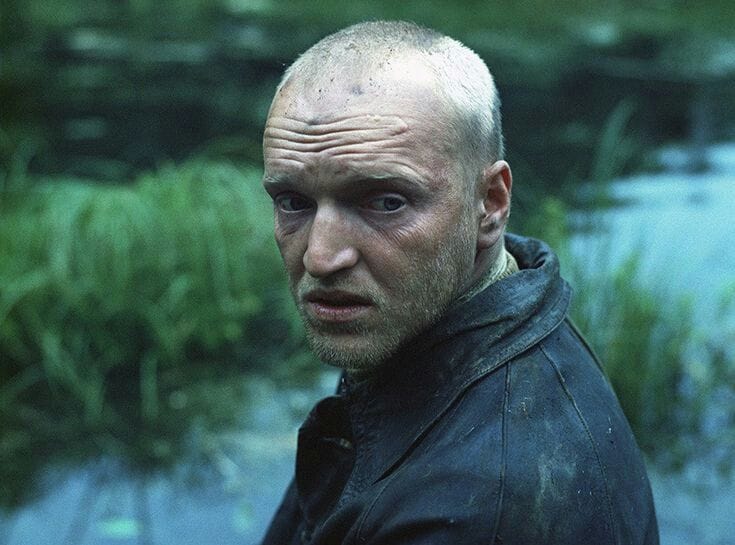
The Stalker himself, played by Aleksandr Kaidanovsky, is a study in exposed interiority. His eyes are permanently unsettled, his movements careful, almost apologetic. With very little dialogue, he conveys vulnerability, faith, and a kind of exhausted devotion. When he finally reaches the heart of the Zone, it feels as though he is offering up his own heart to the others—only for one of them to contemplate destroying it.
In one sense, this is a classic descent narrative: Conrad-like, perhaps even Faustian. The journey matters more than the destination. Time served is the point—and it is this duration that produces the hypnosis.
Returning to the book for a moment: it contains strategic pauses—mirrors for the contemplative sections Tarkovsky later preserves. Near the end, before the dangers resume, the novel simply stops. Red and Arthur sit on a railway embankment in thick fog, eating, smoking, and waiting. The Zone does nothing. There is no discovery, no decision, no warning. Time stretches without direction. The moment does not explain the Zone; it forces the reader to sit inside it.
Tarkovsky is famous for taking his time, and in Stalker he preserves this kind of pause even as he strips so much else away. A hostile critic might call it indulgence. In practice, it functions as technique. When he finds an image that resembles a moving portrait, he frames it and lets it linger, sometimes for a minute or more. That does not sound long. But when the image is only reeds swaying underwater, the demand becomes clear: surrender to the experience, or grow restless.
This is not mere aesthetic dawdling. Tarkovsky is not chasing beauty for its own sake—many of his images are of decay and dereliction, and Stalker is largely set amid industrial wasteland and marsh. What he is asking the viewer to experience is a journey. The expedition within the film is not meant to unfold in real time; it is understood to take days. For the viewer to feel that passage, Tarkovsky requires that we loosen our own grip on time.
That single minute of contemplation may contain hours of internal movement—thoughts turning over, impatience surfacing, resistance giving way. The world churns. Attention is tested. And if one stays with it, something subtle but unmistakable occurs: the mind begins to settle. The eyes roam the frame, searching for meaning, noticing minutiae, and eventually relinquishing the demand for explanation in favour of flow.
This is hypnosis—not theatrical or coercive, but attentional.
Tarkovsky arrived at this largely by intuition and was openly sceptical of over-interpretation. He cared more for mood and inner state than for symbolism as such. A scene in Stalker illustrates the point. In a swampy stretch of the Zone, a large black dog appears repeatedly in frame. It feels insistently present, difficult not to read as symbolic.
At the screening I attended, a hand went up during the discussion. Tarkovsky pointed to the questioner.
“Mr Tarkovsky,” the man said, “I cannot lose the image of the black dog from my mind. What gave you the idea of representing overbearing Soviet censorship as a black dog?”
Tarkovsky smiled and replied that they had been filming in the marsh for several days. One of the crew fed a stray dog that wandered onto the set, and after that they could not get rid of it. Time was short. The dog remained.
“It did provide a nice visual contrast,” he added.
Meaning does not arise because it is planted. It arises because the viewer brings it. Tarkovsky did not insert symbols; he created conditions. The rest happened in the mind. The point is not whether you read meaning in—the point is that you consent to the tempo, and stay with what is shown long enough for your own mind to change gear.
Each time I watch the film, by the time it is over, my mind feels exercised, yet strangely quieter—like a breather between weights machines at the gym.
My friend asked how to deal with mental turmoil. Tarkovsky offers one answer: give your attention to something crafted and continuous—a distinct image, a sustained moment. Think about it, if you must, but release the demand for resolution. Stay with it. Spend the time.
Postscript
I will now have put many off a work that I personally love. I am ashamed — a smidge. So let me add a reassurance. A film about descent and wish-fulfilment deserves an ending with closure. Tarkovsky delivers—quietly. In the final moments, he offers something so small it can be missed, yet so decisive it shifts the film’s emotional weight. Forewarned or not, you feel it.
Discussion